


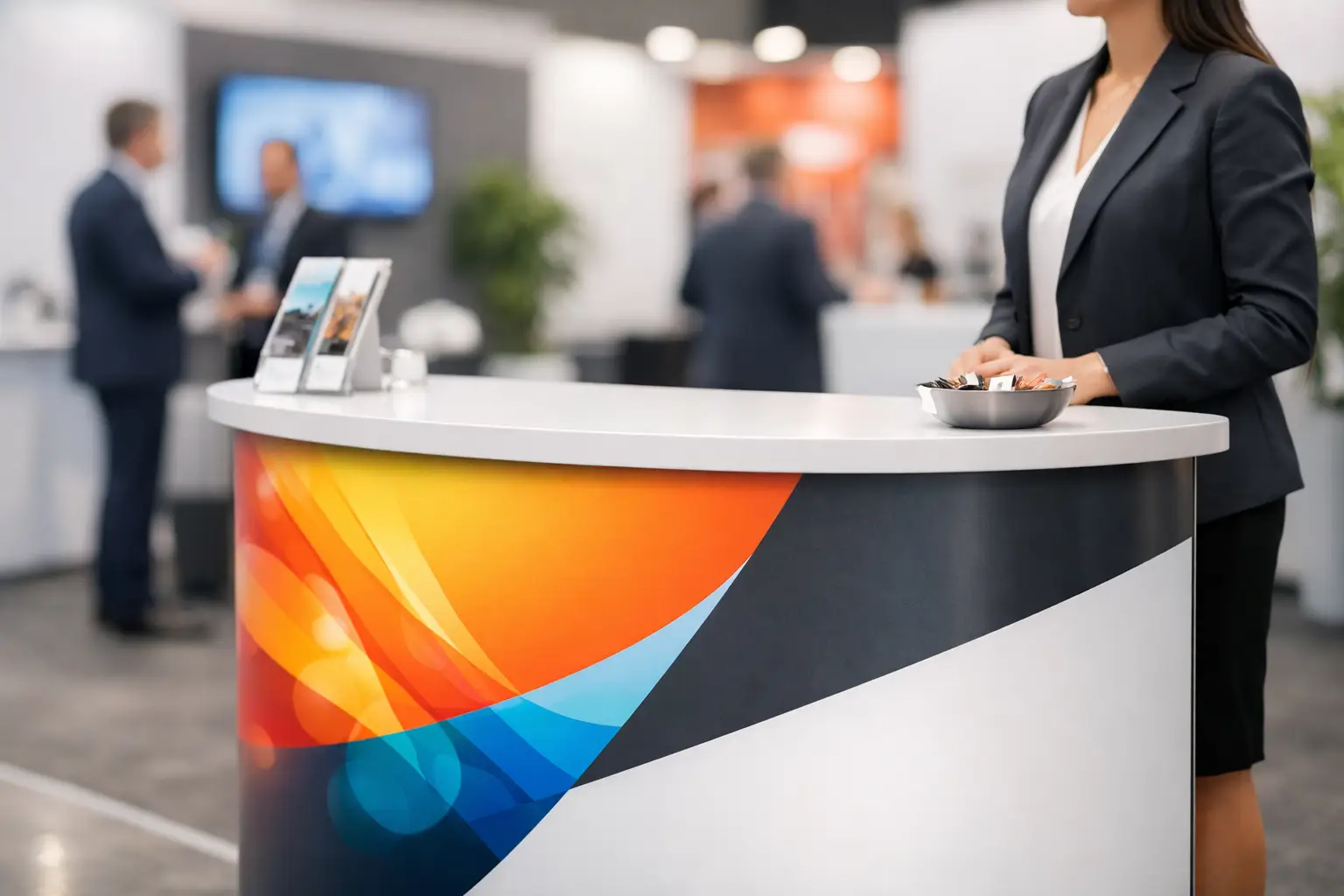
A crowded trade show floor gives you only a few seconds to make the right impression. If you are figuring out how to brand exhibition counters, the goal is not to fill every inch with graphics. It is to make the counter work harder – as a visual anchor, a conversation starter, and a practical part of your booth setup.
For many exhibitors, the counter is where the first real interaction happens. Visitors stop there to ask a question, collect a sample, scan a QR code, or wait while someone explains a product. That makes the counter one of the most valuable branding surfaces in the booth. Done well, it reinforces your message without competing with the rest of the display. Done poorly, it looks like an afterthought and weakens the entire setup.
Why exhibition counter branding matters
Your exhibition counter sits at eye level for standing visitors and near hand level for anyone engaging with your team. That combination makes it unusually effective. People may miss details on a back wall, but they will notice the counter right in front of them.
A branded counter also helps with booth cohesion. When the counter design matches the backdrop, banners, product displays, staff apparel, and printed handouts, your booth feels planned and credible. That matters for corporate buyers, procurement teams, and event attendees who often judge professionalism within moments.
There is also a practical business reason. Booth traffic is expensive. Space rental, setup, transport, printing, and staffing all add up quickly. A counter that clearly communicates who you are and what you offer helps those event dollars work harder.
How to brand exhibition counters with the right objective
Before choosing colors, finishes, or print size, decide what the counter needs to do. Different event goals call for different branding decisions.
If your booth is focused on lead generation, the counter should support quick recognition and easy engagement. Your company name, core service, and a simple call to action should be easy to read from a short distance. If the booth is product-driven, the counter may need to support samples, brochures, or live demonstrations, which means visual branding has to leave enough physical space for use.
If you are exhibiting at a premium industry event, the emphasis may be on polish and brand perception. In that case, a cleaner layout with fewer elements often works better than a busy counter wrap. If the event is high-traffic and promotional, stronger visual impact and bolder messaging may be the better choice.
This is where many exhibitors go wrong. They try to make one small counter carry their full company story. It is usually better to give the counter one clear role and let the rest of the booth handle the rest.
Start with the viewing distance
Good exhibition counter branding begins with visibility. Ask a simple question: what should a visitor understand in one glance?
In most cases, that means your logo, brand colors, and one short message. A counter is not the place for a paragraph of copy, a long list of services, or several competing offers. People approach counters while walking, talking, and scanning the environment. Short, legible messaging performs better than detailed text.
Design for the actual setting, not just the artwork file. A graphic that looks balanced on screen can feel cramped once wrapped around a curved counter or partially blocked by giveaway items. If your counter includes shelves, joints, or folds, those areas need to be considered before finalizing the print layout.
Keep key elements in the safe zone
The center front panel usually gets the most attention, so it should carry the most important branding. Avoid placing logos, QR codes, or critical text too close to edges, seams, handles, or curved corners. These areas can distort the design or reduce readability.
If the counter will be used with a tablecloth, product stand, or stacked materials, account for that too. There is no value in printing a key message where it will be hidden all day.
Choose graphics that match your booth system
The best branded counters do not look separate from the booth. They look like part of one system. That means aligning the counter graphic with your backdrop, pop-up display, brochure stand, and even staff uniform colors.
Consistency does not mean every surface needs the same artwork. In fact, repeating the exact same design across every item can make the booth feel flat. A better approach is to keep the same visual language – logo usage, colors, typography, and brand tone – while giving each surface a specific job.
Your backdrop may carry the big promise. Your counter may carry the logo, a simple value statement, and a clean front-facing visual. Your handouts may hold detailed information. When these pieces are planned together, the whole booth feels more professional and easier to understand.
For businesses managing events on tight timelines, working with one supplier for print production and booth setup reduces the risk of color mismatches, sizing issues, or last-minute fit problems. That coordination matters more than many teams realize until installation day arrives.
Materials and finish affect brand perception
When thinking about how to brand exhibition counters, the print file is only half the decision. Material choice and finishing also shape how your brand is perceived.
A matte finish often gives a more premium, less reflective appearance under exhibition hall lighting. It is a strong choice for corporate presentations, B2B events, and booths where glare could affect readability. Gloss can make colors look more vivid, but it may also reflect overhead lights and fingerprints more easily.
Fabric wraps can offer a cleaner, modern look and are often easier to transport, while rigid graphic panels can provide a sharper structure depending on the counter style. The right option depends on how often the counter will be reused, how it will be packed, and how polished the final setup needs to look.
Durability matters too. Exhibition counters are touched constantly. Visitors lean on them, staff place laptops and samples on them, and setup crews move them between venues. If you expect repeated use, invest in print materials that can hold color well and resist scuffing. Lower upfront cost can become expensive if the counter needs replacing after a few events.
Balance branding with function
A counter is not just a print surface. It is a working part of the booth. That sounds obvious, but it often gets overlooked during design approval.
Your team may need space for registration, product samples, gift packs, forms, or a tablet stand. If the design assumes a perfectly empty countertop, the real event setup may cover the branding and create visual clutter.
Think through use before printing. Will the counter hold merchandise? Will visitors gather around it for demos? Will there be storage behind it? Should the front panel include a QR code, or would that be more effective on a standing sign where people can scan without blocking traffic?
Functional branding usually performs better than decorative branding. A well-branded counter supports staff workflow, keeps the booth tidy, and directs visitor behavior naturally.
What to include on the counter
Most counters need only three things on the main visible panel: your logo, a short message, and a strong visual identity through color or imagery. Sometimes even that is too much, especially if the booth backdrop already carries a headline.
If you want to add a QR code, promotional line, or campaign slogan, test whether it can be read and understood quickly. If not, it belongs elsewhere. The counter should reduce friction, not create it.
Common mistakes when branding exhibition counters
One common mistake is overcrowding. Companies try to include every product category, website detail, social icon, and campaign line on a surface that should stay simple. The result is visual noise.
Another is poor scaling. A logo that is too small disappears from a distance, while one that is oversized can make the counter feel unbalanced. The right scale depends on the counter size, viewing angle, and what else appears nearby.
Low-resolution artwork is another issue, especially when old brand files are stretched to fit a large print area. Exhibition graphics need production-ready files. Otherwise, the counter may look acceptable from afar but poor up close, which is exactly where visitors will be standing.
The final mistake is treating the counter as a standalone purchase instead of part of the event environment. Branding works best when the counter is planned alongside the full booth setup, not after everything else has already been decided.
A practical approach to how to brand exhibition counters
Start with your event goal, then define the counter’s role within the booth. From there, choose a layout that prioritizes immediate recognition. Keep text brief, place important elements in visible areas, and make sure the design fits the counter structure.
Next, review material and finish based on venue lighting, transport needs, and frequency of reuse. Then check alignment across the rest of your booth assets so the counter feels integrated, not improvised.
If you are managing a launch, roadshow, trade fair, or school event with multiple branded items involved, this is where an experienced production partner can save significant time. Global Asia Printings supports businesses that need not just print output, but practical guidance on artwork setup, brand consistency, and event-ready execution.
A well-branded exhibition counter does not need to be loud. It needs to be clear, useful, and consistent with the impression your team wants to leave once the conversation starts.