


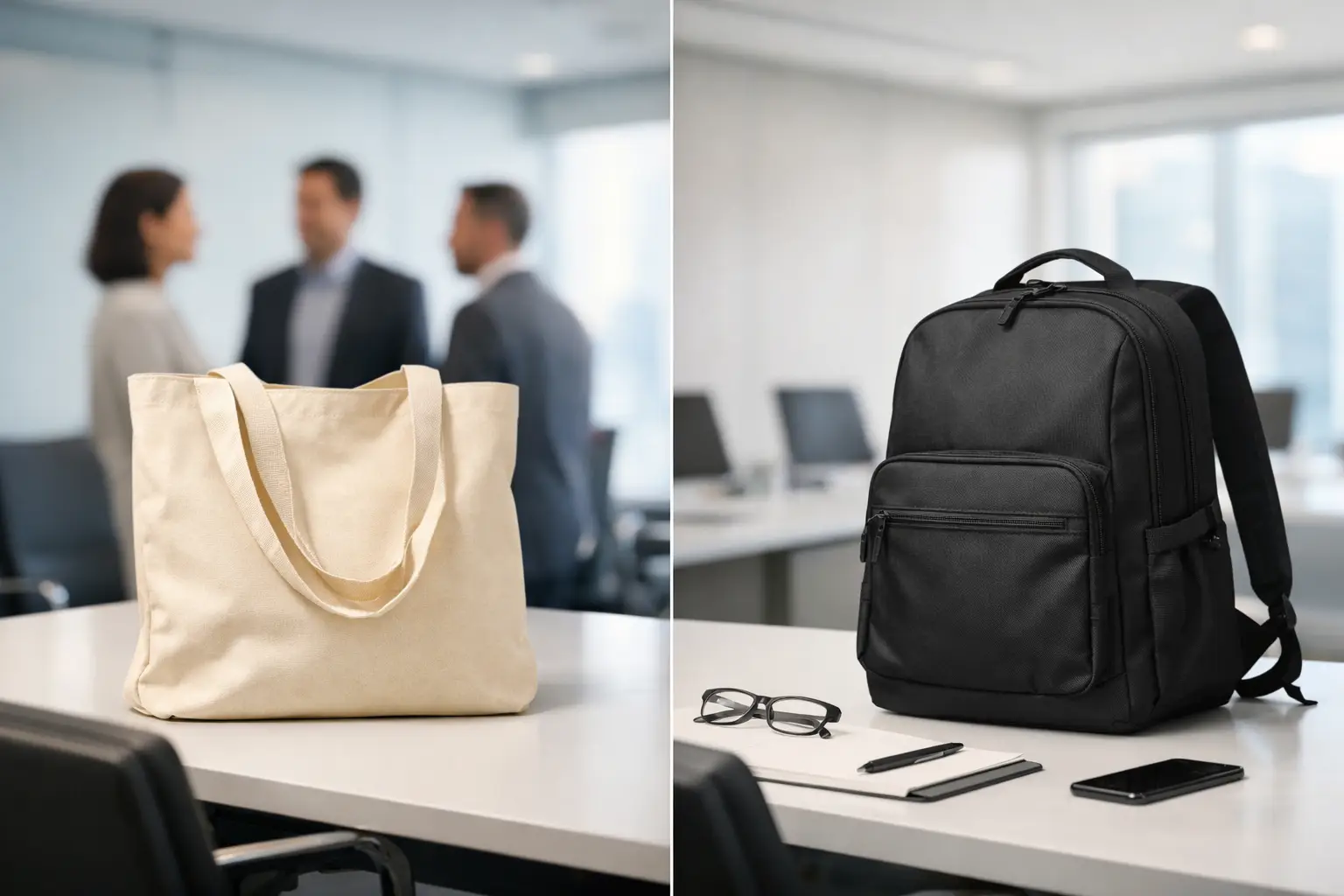
A branded bag is rarely just a giveaway. It carries event materials, makes a first impression at registration, and can keep promoting your organization long after the event ends. When comparing tote bags versus backpacks, the better choice depends on what recipients need to carry, where they will use the bag, and how prominently your brand needs to appear.
For a one-day exhibition, a lightweight tote may be the practical answer. For an employee onboarding kit, school program, or outdoor team event, a backpack often delivers more perceived value and everyday usefulness. The strongest choice is not necessarily the most expensive option. It is the one that fits the occasion, audience, artwork, and budget.
Tote Bags Versus Backpacks: The Core Difference
Tote bags are simple, open-top or zip-top carry bags with handles that sit on the shoulder or in the hand. They are lightweight, easy to distribute, and available in materials ranging from non-woven polypropylene to cotton canvas, jute, recycled fabric, and laminated finishes. Their broad, flat panels give logos, campaign graphics, and event messaging room to stand out.
Backpacks are built for comfort and capacity. With two shoulder straps, a structured body, and often several compartments, they suit recipients carrying laptops, documents, water bottles, uniforms, or personal belongings. They tend to feel more substantial, which can make them a better fit for employee gifts, executive programs, student events, and longer campaigns.
The trade-off is straightforward: totes generally offer a lower entry cost and larger uninterrupted print areas, while backpacks provide better carrying comfort and higher practical value. Neither is automatically better. The use case should lead the decision.
When a Tote Bag Makes Better Business Sense
A tote bag works especially well when you need a high-volume item that is easy to hand out, pack, and transport. At trade shows and conferences, attendees can immediately use it to collect brochures, samples, catalogs, and gifts from the event floor. That instant utility increases the chance that your bag will be carried throughout the venue, putting your branding in view.
Totes are also effective for retail promotions, community outreach, fundraising events, product launches, and welcome packs. A canvas tote can feel polished enough for client-facing occasions, while a non-woven tote is a practical choice for large-scale distribution where cost control matters.
From a branding perspective, the tote has a major advantage: its main panel is usually flat and visible. A full-color graphic, event theme, sponsor lineup, or bold campaign message can be printed clearly without competing with pockets, zippers, or straps. This makes tote bags a strong option when visual impact is the priority.
Material selection matters. Non-woven bags are economical and lightweight, but they are better suited to short-term or moderate use. Cotton and canvas totes have a more premium feel and can last longer, particularly when reinforced handles and a gusseted base are included. For organizations emphasizing environmental responsibility, reusable materials can support the message, provided the bag is durable enough to be used repeatedly.
A tote may be less suitable when recipients must carry heavy items or travel long distances. Thin handles can become uncomfortable, and an unstructured bag does not protect electronics or keep contents organized. If your event kit includes a laptop, bulky apparel, or several premium gifts, a tote can quickly become more of a burden than a benefit.
When a Backpack Is Worth the Investment
Backpacks are designed for recipients who need their hands free and their belongings secure. They are a natural fit for corporate retreats, employee appreciation programs, school orientations, sports events, outdoor activations, and travel-related campaigns. A well-chosen backpack can become part of a recipient’s weekly routine, extending brand exposure far beyond the original event.
For internal company programs, backpacks can communicate a stronger sense of investment than a basic giveaway. A new-hire backpack filled with a notebook, drinkware, apparel, and welcome materials feels organized and considered. The same applies to training sessions where attendees need to carry documents, devices, and personal items between venues.
Backpacks also bring functional details that matter in real use. Padded straps, laptop sleeves, zippered compartments, side bottle pockets, and water-resistant materials can make a noticeable difference. These features are especially valuable for commuters, students, field teams, and event staff who will carry the bag for hours.
The challenge is that backpacks require more thoughtful specification. A low-cost backpack with weak stitching, thin straps, or poorly aligned printing can undermine a premium campaign. Branding placement is also more limited because front pockets, curved surfaces, and seams affect the printable area. A clean logo on the front panel often performs better than artwork that is too detailed or too large.
Backpacks generally take up more storage space before an event and may involve a higher unit cost. For a campaign serving thousands of casual visitors, that investment may not be necessary. For a smaller group of valued employees, partners, or attendees, however, the perceived value can justify the difference.
Compare Print Area, Brand Visibility, and Decoration Methods
The best bag design starts with the intended decoration method, not just the logo file. Tote bags commonly support screen printing, heat transfer, digital transfer, embroidery, and full-color printing depending on the material. Because the panel is flat, artwork is often easier to position and reproduce consistently across a large order.
Backpacks can also be screen printed, heat transferred, embroidered, or finished with branded patches. Embroidery gives a refined, durable result for uniforms, staff packs, and higher-end corporate gifting, while a printed transfer may be better for colorful event graphics. The right method depends on the fabric, logo detail, number of colors, and expected wear.
Do not assume the largest logo creates the best result. On a tote, oversized graphics can work when the campaign is visual and bold. On a backpack, a smaller, well-positioned logo may look more professional and remain legible from a distance. Artwork should be adjusted to the specific bag rather than copied across every product without review.
For multi-sponsor events, tote bags offer more usable space for logos and partner recognition. For a single-brand employee gift, a backpack with discreet branding can feel more premium. This is where practical artwork guidance can prevent costly revisions or a design that looks crowded after production.
Budget, Quantity, and Event Logistics
Cost should be assessed beyond the unit price. Consider how many items each bag must carry, whether the bags need to be packed in advance, and how they will be distributed on site. A low-cost tote that tears under the weight of event materials can create a poor recipient experience. A high-spec backpack issued to a one-time visitor may add cost without adding meaningful return.
For larger quantities, tote bags usually provide more flexibility across price points. They are easier to fold, store, and transport, which can reduce logistical pressure before a major conference or roadshow. Backpacks require more volume, but they can reduce the need for separate packaging because they hold the other giveaway items themselves.
Lead time is another practical consideration. Custom bags may require time for sourcing, sample review, artwork confirmation, printing, quality checks, and delivery. If you have a fixed launch date or event opening, decide on the bag format early. The more customized the bag construction and decoration, the more planning it deserves.
At Global Asia Printings, project guidance often begins with these operational questions: who will receive the bag, what will go inside it, how many are needed, and when must it arrive? Clear answers make it easier to recommend a bag that meets both presentation and budget requirements.
Choose Based on How the Bag Will Be Used
Choose a tote when you need broad brand visibility, a cost-effective distribution item, and enough space for light event materials. It is particularly effective for exhibitions, retail campaigns, conferences, and community programs where attendees benefit from carrying items immediately.
Choose a backpack when comfort, organization, and long-term use matter more. It is a stronger option for staff, students, commuters, VIP attendees, and recipients who will carry heavier or more valuable items. It can also make a welcome kit or appreciation gift feel more complete.
If your audience includes different types of recipients, a two-tier approach can work well. Provide totes for general event attendees and reserve backpacks for speakers, crew, partners, or employees. This keeps the broader campaign accessible while giving priority groups a more substantial item.
Before approving production, put a sample bag on the table and fill it with the actual materials you plan to distribute. Carry it, check the print placement from a few steps away, and consider whether a recipient would use it again next week. That simple test usually makes the right choice much clearer.