


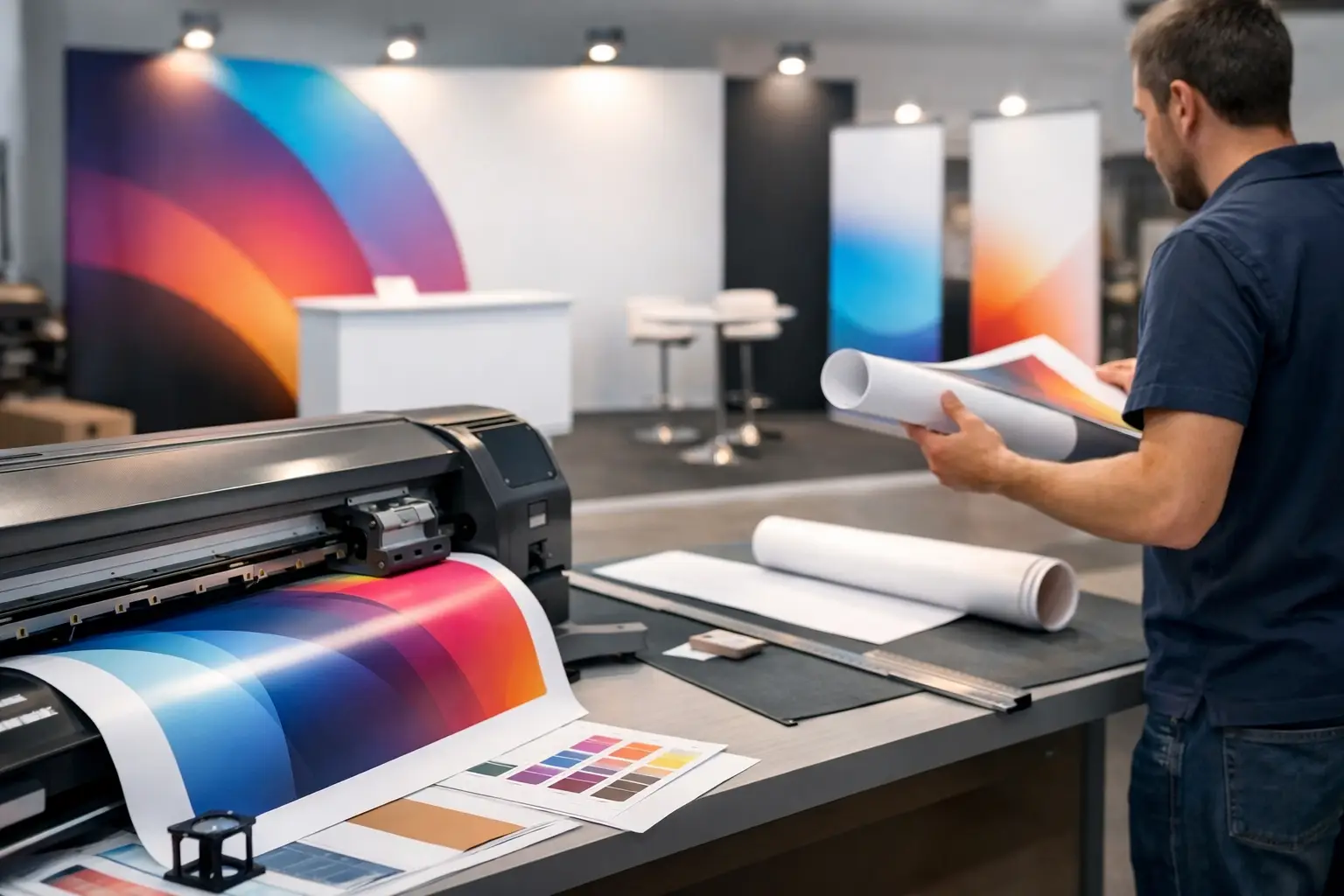
Trade show problems rarely start on event day. They start earlier – with artwork built at the wrong size, a logo placed too close to the edge, or a beautiful design approved without checking how it will print on fabric, foam board, or sticker media. A practical exhibition booth printing guide helps prevent those expensive mistakes before your team is standing on the show floor with no time to fix them.
For most businesses, booth printing is not just about making a space look branded. It is about making the brand legible, credible, and consistent from a distance, under venue lighting, and across every touchpoint – backdrop, counter wrap, brochure stand, directional signage, table cover, and promotional materials. Good booth printing supports sales conversations. Poor booth printing creates distractions your team has to explain away.
What an exhibition booth printing guide should help you decide
The real job of booth printing is to make fast decisions easy for visitors. People do not stand still and study every panel. They walk past, glance sideways, stop only if the message is clear, and move on if the design feels cluttered or generic. That means your print choices need to support visibility first, then detail.
Start by thinking about the booth as a system rather than a single backdrop. A branded wall may attract attention, but the rest of the printed elements shape the experience. Counter graphics reinforce the main message. Product labels reduce repetitive questions. Hanging signs help visitors locate your booth from farther away. Handouts and take-home items continue the conversation after the event.
This is where many teams overdesign one centerpiece and underplan everything else. The stronger approach is to decide what each printed surface needs to do. Some pieces need impact. Some need information. Some simply need to keep the space looking finished and professional.
Choose materials based on use, not just price
Material selection affects appearance, durability, installation, and transport. It also affects how forgiving the print will be under real event conditions. A low-cost substrate may look fine in a sample image but crease easily, reflect harsh lighting, or arrive damaged after transport.
Fabric is a popular choice for large backdrops because it travels well, reduces glare, and can present color smoothly. It works especially well for tension frame systems and photo-heavy artwork. The trade-off is that certain fabrics can soften very small text, so they are better for bold messages than dense information.
Foam board can be useful for lightweight mounted signage and short-term indoor displays. It is affordable and visually clean, but it dents more easily than more rigid alternatives. If your booth setup involves repeated use, frequent transport, or rough handling, a sturdier board may be the smarter investment.
Vinyl remains a dependable option for banners, wall graphics, and counter wraps. It offers good print sharpness and flexibility across many applications. Still, not every vinyl finish behaves the same. Gloss may make colors pop but can catch overhead light. Matte often reads better in exhibition halls where glare is a problem.
Rigid boards, acrylic panels, and specialty finishes can elevate presentation when the event matters enough to justify the spend. Product launches, investor showcases, and premium industry exhibitions often benefit from higher-end display materials. But premium only works when the design is restrained. Expensive printing cannot rescue crowded messaging.
Artwork setup is where quality is won or lost
Many print issues are file issues in disguise. The booth looks blurry, colors shift, or text gets trimmed, and the problem is blamed on production when the root cause was the artwork preparation.
For large-format booth graphics, scale and resolution need to be planned together. A file does not need to be built at full size if it is created correctly to scale, but the final output still needs enough effective resolution for viewing distance. A backdrop seen from six feet away has different requirements from a tabletop product card viewed up close.
Bleed, safe zones, and panel breaks matter more than many buyers expect. If your design spans multiple panels or wraps around a counter, the supplier needs to know exactly where seams, folds, and edges will fall. Critical text and logos should never sit in those danger zones. This seems obvious until someone approves a layout based on a flat PDF rather than the actual assembled structure.
Color is another common surprise. Screens are backlit. Printed materials are not. Venue lighting changes how colors appear, and different media absorb ink differently. Brand consistency is possible, but it requires practical expectations and proper file handling. If color accuracy is especially important, it is worth discussing proofs or material-specific adjustments before full production.
Keep booth messaging short enough to work
The most effective booth graphics usually say less than internal stakeholders want. Marketing wants campaign language. Sales wants product detail. Leadership wants every service listed. The result is often a wall of text that nobody reads.
A better rule is to give the main backdrop one job: communicate who you are and why someone should stop. That may be a clear service category, one strong value proposition, and a supporting visual. Secondary printed pieces can carry the deeper information.
If your team offers multiple services, group them intelligently instead of listing everything at equal weight. Visitors should be able to understand your core offer in a few seconds. If they are interested, your staff can do the rest.
Readable type also matters more than style. Thin fonts, low-contrast color pairings, and oversized paragraphs may look polished on a laptop but fail on a show floor. Strong booth graphics favor contrast, hierarchy, and restraint. If it cannot be read while someone is walking by, it is not helping.
Plan the booth printing timeline backward from installation
Late approvals are one of the biggest risks in exhibition printing. Teams often count only the print production window and forget design revisions, material selection, prepress checks, finishing, packing, delivery coordination, and setup scheduling.
The practical way to manage this is to work backward from installation time, not event opening time. If the booth must be ready the night before, your true deadline is earlier. If the venue has restricted loading hours, your margin is smaller still.
A reasonable production plan also accounts for rework risk. Maybe the venue changes the booth dimensions. Maybe a sponsor logo gets updated. Maybe one file exports incorrectly. Short lead times can be managed, but only if everyone knows what has been approved and who is responsible for the next step.
This is where working with one vendor for printing and booth execution can save time. The printer is not guessing how the graphics will fit because the same team understands the physical setup. That reduces the back-and-forth that often happens when design, printing, and installation are split across separate suppliers.
Budget decisions that actually matter
Not every booth needs the highest-end print package. The right spend depends on event goals, booth size, reuse potential, and audience expectations. A one-day internal fair has different needs from a major public expo.
If budget is tight, prioritize what attendees will notice first. Invest in the main backdrop, front-facing counter graphics, and any sign that carries your core message. You can often save on less visible elements without hurting the overall impression.
Reuse is another cost factor worth discussing early. A date-specific campaign headline may be fine for a single event, but evergreen branding can stretch the value of a booth system across multiple shows. Sometimes the best option is a modular approach – reusable structural graphics paired with smaller replaceable panels for event-specific messaging.
An experienced supplier should be able to guide these trade-offs instead of simply quoting the cheapest material. That is often where businesses save more in the long run: fewer print failures, fewer rush charges, and fewer pieces that need to be replaced after one use.
Final checks before anything goes to print
Before production starts, confirm dimensions against the final booth plan, review artwork on the actual print templates, check spelling and contact details, and make sure logos are high resolution. Also confirm finishing requirements such as eyelets, hemming, lamination, mounting, or frame compatibility. These details sound small until one missing specification delays the entire setup.
For companies managing events, procurement, and branded merchandise at the same time, booth printing is easiest when it is treated as part of a larger execution plan rather than a last-minute design task. That is usually the difference between a booth that merely fills a space and one that helps your team sell, present, and follow up with confidence.
If you are planning for a trade show, roadshow, conference, or campus event, the smartest next step is simple: get the booth objectives, dimensions, artwork, and timeline aligned early. Good printing follows good planning – and when that part is handled properly, the event itself becomes much easier to run.