


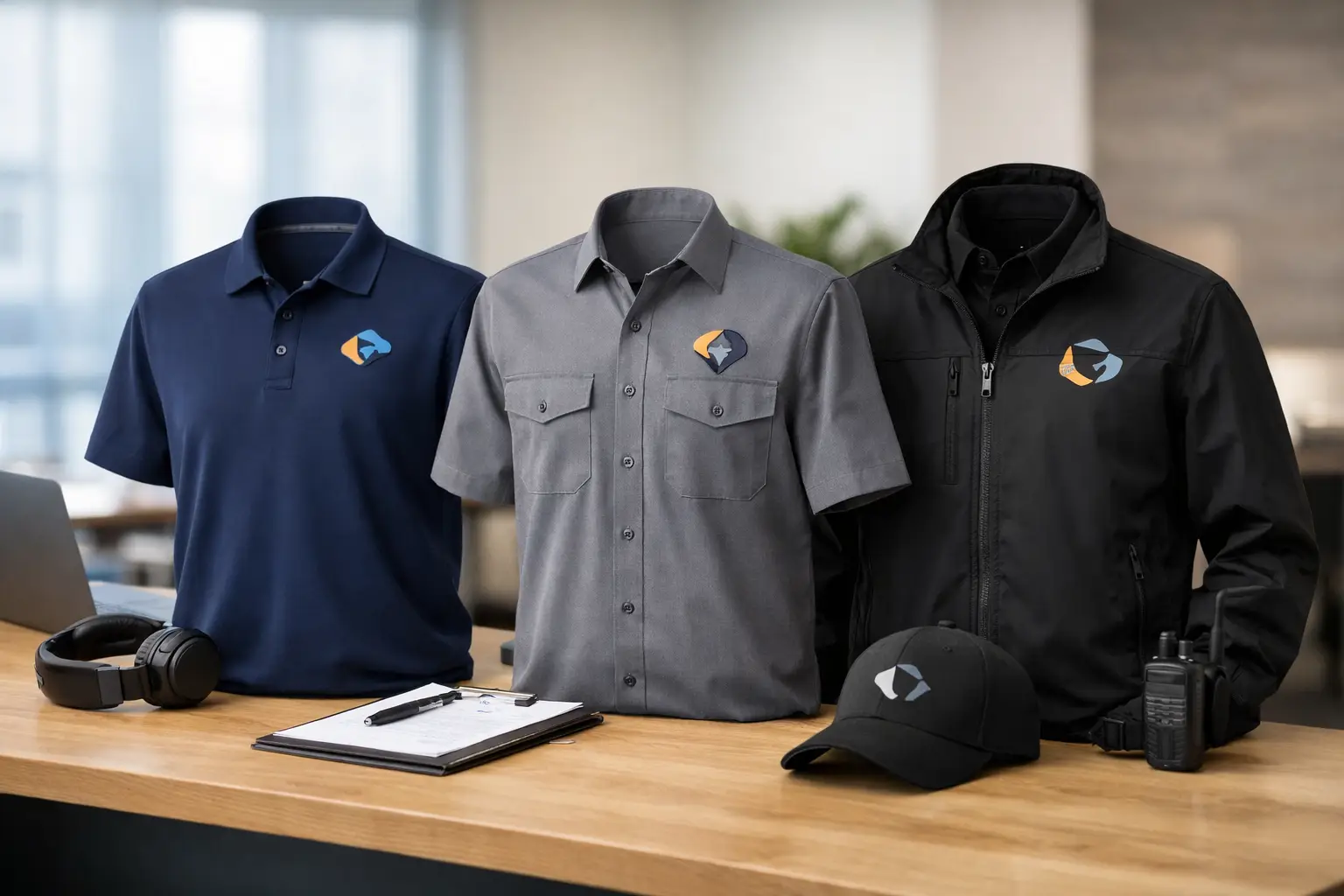
A uniform gets judged fast. Before anyone speaks to your staff, customers notice the logo placement, whether names are readable, and if the overall look feels polished or rushed. That is why deciding what to print on uniforms is not a small design task. It affects brand visibility, team identity, day-to-day usability, and how professional your organization appears in the field, in-store, or at events.
For most businesses, the right print starts with function. A retail polo, a construction site shirt, a school event tee, and a hospitality uniform do not need the same information in the same places. The strongest uniform printing plans balance branding with practical details so the garment works as well as it looks.
What to print on uniforms starts with the job
The first question is not what looks good on a mockup. It is what your staff actually need while wearing the uniform. If employees meet customers directly, your logo and staff names may matter most. If the team works across departments or event zones, job titles or division names can reduce confusion. If the worksite has compliance needs, safety text and identification may take priority over branding.
This is where many companies overprint. They try to fit a logo, slogan, department, website, employee name, title, and campaign message onto one shirt. The result often feels crowded and harder to read. In most cases, a cleaner layout gives better results than trying to use every available print area.
A good rule is to decide which information is essential for recognition, which helps operations, and which is optional. Once that is clear, placement becomes easier.
The most common things to print on uniforms
The company logo is usually the starting point. It is the core branding element and often the one detail every uniform should share. For many organizations, the left chest is the standard placement because it is visible, familiar, and easy to scale across polos, shirts, jackets, and safety wear. A larger back logo can work well for delivery crews, event staff, road teams, and outdoor workers who are often seen from a distance.
Employee names are another strong choice, especially in service businesses. A name creates a more personal customer interaction and helps with accountability. In hospitality, retail, education, healthcare support, and corporate events, this can make a noticeable difference. The trade-off is that named uniforms are harder to reuse when staff turnover is high. For some companies, detachable name tags or role-based shirts make more financial sense.
Job titles or departments can also be useful. Printing “Security,” “Crew,” “Organizer,” “Sales,” or “Technician” on the back or sleeve helps people quickly identify who to approach. This is especially practical during large events, school functions, warehouse operations, and multi-team activations. If your workforce includes several functions in one venue, role labeling often improves flow more than adding extra brand graphics.
Some businesses also print taglines or short brand statements. This can work, but only if the phrase is short and meaningful. A long marketing line usually loses impact on a shirt. If the message does not add clarity or recognition, it is better left off.
Where to place uniform printing
Placement matters almost as much as content. A strong design on the wrong area can still fail in practice.
The left chest remains the most versatile location for logos. It feels professional and suits corporate polos, button-downs, work shirts, and jackets. Center chest prints are bolder and more casual, often used for campaign tees, school shirts, and event apparel. Full-back printing is useful when visibility from a distance matters, such as for logistics, field teams, or brand ambassadors in crowded venues.
Sleeves are often underused, but they can be effective for secondary branding, event names, sponsor marks, or department identifiers. They work best when the main logo is already placed elsewhere and the garment should not feel overloaded.
Not every print location works for every garment. Pockets, seams, zippers, reflective strips, and fabric stretch zones can limit usable space. That is why artwork planning should always happen with the actual garment style in mind, not just a flat design file.
What to print on uniforms for different business needs
There is no single answer to what to print on uniforms because the right combination depends on the setting.
For corporate office and front desk uniforms, a clean logo is often enough. You may add employee names if client interaction is frequent, but the overall look should stay understated and polished.
For retail teams, logo plus name is usually the strongest combination. If the store has multiple service points, adding a role such as “Alterations” or “Manager” can help customers find assistance faster.
For event crews, print should focus on visibility and function. A front logo with a large back role label like “Staff,” “Crew,” or “Registration” is often more useful than a decorative design. Event environments move quickly, and people need to identify your team at a glance.
For industrial, logistics, and site-based teams, practical details may matter most. Company branding is still important, but so are readable names, unit identifiers, and any required safety markings. In these cases, print should support operations first and marketing second.
For schools, nonprofits, and temporary programs, budget and reuse matter more. It may be better to print the organization name and event title without individual names so leftover stock can be used again.
Choosing between logo-only and personalized uniforms
Many buyers hesitate at this stage because personalization feels more premium, but it is not always the best operational decision.
Logo-only uniforms are easier to reorder, redistribute, and hold as inventory. They work well for larger teams, rotating staff, and organizations that need flexibility across departments or seasons. They also simplify replacement orders.
Personalized uniforms offer a stronger service experience. Names and roles can improve trust, especially in customer-facing environments. But they require tighter size tracking, more artwork coordination, and less room for staffing changes. If your headcount changes often or uniforms are shared, personalization may create unnecessary cost.
A practical middle ground is partial personalization. For example, keep all front branding standard and use the back print for reusable department labels instead of individual names.
Keep the design readable, not just branded
Uniform printing often gets treated like a miniature ad. That is where things go wrong. A uniform is worn in motion, under different lighting, across different body sizes, and after repeated washing. If text is too small, colors have weak contrast, or placement feels unbalanced, the print may look fine on screen but poor in real use.
Readable fonts matter. High-contrast color combinations matter. So does scale. A chest logo that is too tiny disappears from a few feet away, while an oversized print can look awkward on smaller garment sizes. Designs should be tested across the full size run, not approved from one sample size alone.
This is also where print method comes into play. Embroidery can give logos a premium, durable look on polos and workwear, while screen printing is often better for larger graphics and volume orders. Heat transfer can help with names, numbering, and variable data. The right choice depends on fabric, budget, artwork detail, and quantity.
Think beyond appearance
Uniforms do branding work, but they also affect operations. A well-planned print can reduce confusion at events, support faster customer service, and help staff feel part of one team. A poorly planned one can create inventory waste, reprint costs, and a less professional presentation.
That is why businesses should decide early whether the uniform is mainly for brand visibility, employee identification, team hierarchy, compliance, or a mix of these. Once that purpose is clear, it becomes much easier to choose what belongs on the garment and what does not.
At Global Asia Printings, this is usually where the best projects take shape – not from adding more, but from aligning the uniform with how the team actually works. When the print matches the environment, the garment stops being just apparel and starts doing a job.
If you are planning your next uniform order, aim for information that is useful on the floor, visible at a glance, and consistent with your brand. The best print is not the one with the most elements. It is the one your team can wear with confidence and your audience can understand immediately.