


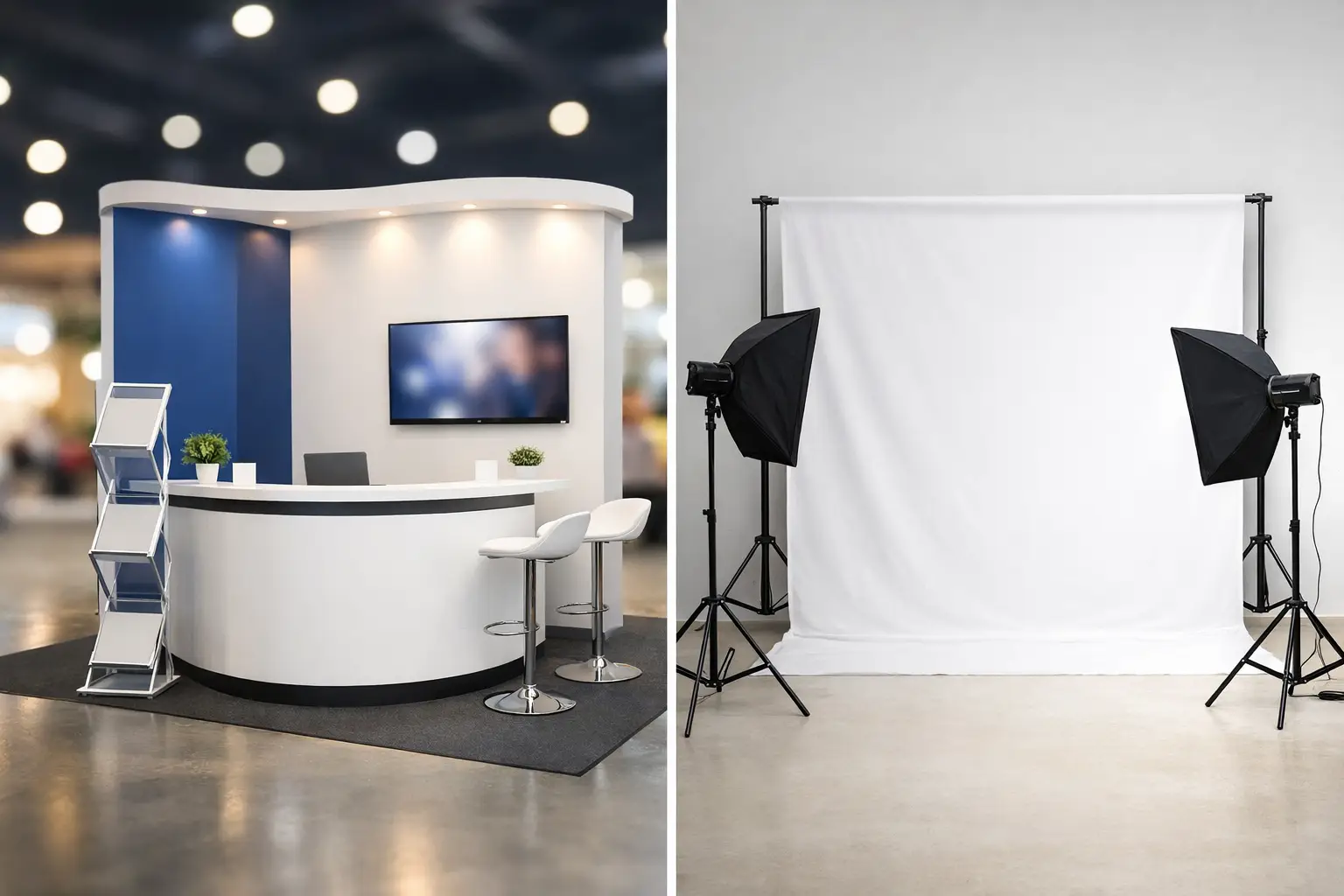
You can spot the wrong event setup almost immediately. A team arrives with brochures, samples, and lead forms, but the space only has a printed backdrop and no room to engage. Or the opposite happens – a full booth is installed for a simple photo opportunity, and the budget gets stretched where it did not need to. When clients ask about event booth vs backdrop, the real question is usually this: what does the event need your brand to do?
That distinction matters because a booth and a backdrop solve different problems. One is built for interaction, product display, and traffic flow. The other is built for visibility, photography, and a clean branded presence. Choosing well saves budget, reduces setup issues, and helps your team show up prepared instead of improvising on event day.
Event booth vs backdrop: the core difference
An event booth is a structured event space. It is designed to support activity – meeting attendees, displaying products, running demos, collecting leads, hosting staff, and sometimes even storing materials. Depending on the venue and objective, it may include walls, counters, shelves, TV mounts, lighting, product display areas, and custom graphics.
A backdrop is much simpler. It is usually a printed visual panel or banner wall used behind a registration table, stage area, media line, or photo area. Its main job is brand visibility. It gives your event a polished branded frame without requiring the footprint, materials, or setup complexity of a full booth.
If your team needs people to stop, browse, ask questions, or experience something hands-on, a booth is often the better fit. If your goal is to make the brand visible in photos, define a space, or support a short-term activation with minimal installation, a backdrop may be all you need.
When an event booth is the right choice
A booth makes sense when interaction is the priority. Trade shows, expos, campus fairs, roadshows, and corporate showcases usually demand more than a visual background. In these settings, your brand needs a place where staff can stand comfortably, greet visitors, hand out samples, display merchandise, and keep the presentation organized.
Booths also help when your product or service requires explanation. If you are launching new merchandise, demonstrating equipment, introducing a service package, or meeting buyers face to face, the physical setup becomes part of the sales process. A table alone often looks temporary. A booth gives structure and signals that your company came prepared.
There is also a practical side to it. A booth can hide clutter, provide storage, manage visitor flow, and separate your space from neighboring exhibitors. That matters in busy venues where visual competition is high and every square foot needs to work harder.
The trade-off is cost and logistics. Booths require more planning, more production, and more coordination with venue rules. Delivery timing, installation windows, electrical requirements, and size restrictions all need to be checked early. If the event itself is brief or low-touch, a booth may be more infrastructure than you actually need.
When a backdrop is the better fit
A backdrop works best when your main objective is brand presence rather than sustained interaction. Company dinners, award ceremonies, media events, press walls, employee engagement days, launch moments, and simple registration areas often benefit more from a strong branded visual than a full exhibition structure.
Backdrops are especially effective when photography matters. If guests, speakers, or partners will be taking pictures, a well-designed backdrop keeps your brand visible without overcrowding the space. It creates a cleaner impression than scattered standees or loose signage, and it helps standardize how the brand appears across event photos.
They also make sense for leaner budgets and shorter lead times. Compared with custom booth structures, backdrops are typically faster to produce, easier to transport, and quicker to install. For teams managing multiple event touchpoints at once, that simplicity can be a major advantage.
Still, a backdrop has limits. It does not create much functional space. It cannot support many product displays, conceal supplies, or accommodate longer conversations with visitors in a comfortable way. If your team shows up with catalogs, giveaways, and meeting needs, a backdrop alone may leave them under-equipped.
Cost is not just about the printed structure
Budget discussions around event booth vs backdrop often start with print size and material, but that is only part of the picture. The bigger cost difference usually comes from function.
A backdrop is generally more economical because it has a narrower purpose. You are paying for branded presentation and basic physical presence. Setup tends to be simpler, and storage or reuse can be easier depending on the system.
A booth costs more because it does more. Beyond printed graphics, you may be investing in framework, counters, carpentry, shelving, wiring access, lighting, display fixtures, transport coordination, and labor for setup and teardown. If the event runs over several days, staffing and replenishment planning may also become part of the real cost.
That does not mean the cheaper option is the better value. If a booth helps your team generate stronger leads, support demos, and handle visitor traffic professionally, it can justify the higher spend. On the other hand, if the event is mainly a branding opportunity with limited attendee interaction, spending on a full booth can dilute your budget without adding meaningful return.
Space, venue rules, and timing can make the decision for you
Sometimes the choice is strategic. Sometimes it is simply operational.
A compact venue with tight load-in access may favor backdrops over booth structures. A mall atrium activation may require a booth that can handle foot traffic and product display. A ballroom pre-function area might only have room for a registration counter with a backdrop. Venue rules on height limits, build materials, installation hours, and power access can quickly narrow your options.
Lead time matters too. Booths usually need earlier planning because artwork, fabrication, approvals, and installation logistics involve more moving parts. Backdrops can be more forgiving for shorter timelines, though rush jobs still carry risk if design and print files are not ready.
This is where working with one production partner can reduce friction. Instead of splitting print, hardware, branded giveaways, and setup across several vendors, you get better alignment on dimensions, deadlines, and on-site needs. For event teams already balancing attendee lists, internal approvals, and program schedules, that operational clarity matters as much as the final visual.
How to choose between an event booth and backdrop
Start with the event goal, not the format. If success means collecting leads, supporting conversations, and showcasing products, lean toward a booth. If success means visible branding, polished photos, and a clean event setup, lean toward a backdrop.
Then look at what your team needs on-site. Will staff need storage, tables, display surfaces, or room to host visitors? If yes, a booth is likely the better choice. If your event team mainly needs a branded focal point behind a reception area or photo spot, a backdrop is usually enough.
Next, check the venue realities. Footprint, installation timing, and access restrictions often change what is practical. It is better to choose a format that fits the site cleanly than to force a larger concept into a space that cannot support it.
Finally, weigh reuse. Some businesses attend multiple events each year and benefit from modular booth systems or branded backdrop kits they can redeploy across campaigns. A one-off event may justify a simpler setup. A recurring exhibition calendar may justify a more developed structure that pays off over time.
In some cases, the best answer is both
This is where the conversation gets more practical. Event booth vs backdrop is not always an either-or decision.
Many successful setups combine both. A booth handles visitor engagement and product display, while a separate backdrop supports photography, media moments, or sponsor visibility. At corporate events, a branded booth can anchor interaction in one zone while a backdrop supports stage programming or guest arrivals in another. Used properly, they complement each other rather than compete.
For buyers planning a campaign instead of a single print item, this broader view often leads to better results. The question shifts from Which one is better? to Which combination supports the event experience, budget, and brand goals most effectively?
At GAPS, that is usually how the planning starts – with the event objective, the practical site conditions, and the materials your team actually needs to execute well. The right setup should not just look branded. It should make the event easier to run.
A good event presence is rarely about choosing the biggest setup. It is about choosing the one that works hardest for the job in front of you.