


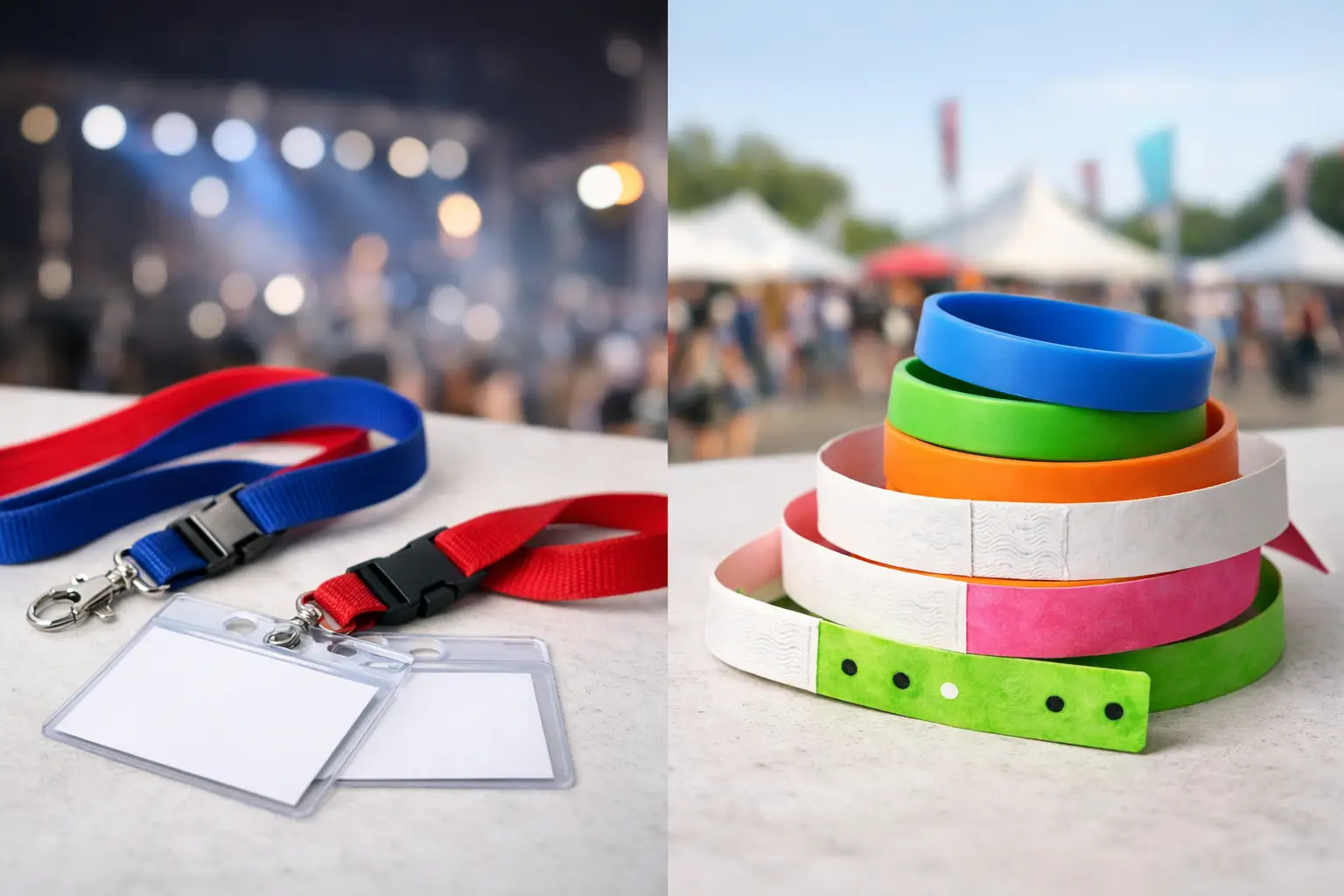
A registration table can be the first point of friction at an event. Guests are arriving, staff are checking names, sponsors are watching, and someone is asking whether VIP access is clearly marked. The decision between lanyards vs wristbands for events affects more than what attendees wear. It shapes check-in speed, access control, brand visibility, staffing needs, and the impression people take away from the day.
For corporate functions, conferences, school programs, exhibitions, product launches, and ticketed activations, there is no automatic winner. Lanyards generally offer more information and a more professional credential format. Wristbands are faster to issue, easier to spot from a distance, and often more practical for active or high-volume events. The right choice depends on how your event operates once the doors open.
Lanyards vs Wristbands for Events: The Core Difference
A lanyard is a wearable strap, typically fitted with a badge holder, card, or custom pass. It is designed to display identification, schedules, QR codes, names, sponsor logos, or access categories at chest level. It works especially well when guests, employees, exhibitors, and speakers need to be recognized throughout the event.
A wristband is secured around the attendee’s wrist and usually indicates admission, access level, age verification, or a specific participation category. It is compact, hard to overlook, and convenient for venues where security teams need to make quick visual checks.
The practical distinction is simple: lanyards communicate details, while wristbands communicate permission. Many events need one more than the other. Some benefit from using both.
When Lanyards Are the Better Event Credential
Lanyards are often the stronger choice for business-facing events where identification matters. At a conference or trade show, a printed badge can carry an attendee’s name, company, job title, session access, and QR code. That information supports networking while helping organizers direct people to the right areas.
They also create a larger branding surface. A custom-printed lanyard can carry a company logo, event theme, sponsor name, or campaign message along its full length. Paired with a well-designed badge insert, it turns a basic entry pass into a visible part of the event identity.
For internal company programs, lanyards can help staff distinguish between organizers, delegates, speakers, vendors, and security personnel. This is useful at leadership meetings, town halls, training days, and multi-location corporate events where participants may not know one another. Clear identification reduces interruptions and helps the event feel organized from the start.
Lanyards also suit events that require reusable credentials. Premium woven or dye-sublimated lanyards, retractable badge reels, and durable card holders can be retained for future programs or issued as part of an employee kit. If the event has a formal or professional setting, this polished presentation can justify the added cost.
There are trade-offs. Lanyards take longer to assemble if badges must be inserted individually, and they can be inconvenient for fitness activities, water-based events, or crowded festival-style environments. They may also be removed and passed to someone else unless staff check the badge photo or name against a registration list.
Best uses for lanyards
Lanyards work particularly well for conferences, exhibitions, seminars, school events, corporate training, press events, executive meetings, and events with exhibitors or multiple attendee categories. They are also a good choice when a sponsor needs meaningful logo exposure beyond a small printed mark.
When Wristbands Make More Sense
Wristbands are built for speed and visibility. At a busy entrance, staff can apply a wristband in seconds, and security can identify authorized guests without asking them to hold up a badge. That makes wristbands a practical option for open-house events, community days, large employee celebrations, concerts, sporting activities, and family carnivals.
They are especially effective when access is the main requirement. Different wristband colors can separate general admission, VIP guests, meal-package holders, children, staff, or approved backstage personnel. For multi-day events, dated or serialized wristbands can help control re-entry and reduce confusion at the gate.
Wristbands also perform well in conditions where badges may be inconvenient. Tyvek wristbands are lightweight and cost-effective for one-day programs. Vinyl and fabric options offer greater durability for multi-day activities, outdoor events, and situations where attendees may sweat, exercise, or encounter rain.
From a guest-flow perspective, wristbands reduce handling. Attendees do not need to keep a pass visible, retrieve it from a bag, or worry about a lanyard swinging during an activity. For events with food stations, games, rides, or high foot traffic, that convenience can make a noticeable difference.
The limitation is space. A wristband cannot comfortably carry a full name, job title, agenda, or detailed sponsor message. While custom printing can make it attractive and recognizable, it is not a replacement for a credential when networking or personal identification is central to the event.
Best uses for wristbands
Wristbands are a strong fit for admission control, outdoor activations, company family days, sports events, food and beverage access, venue zones, student activities, and high-volume events where fast entry matters more than displayed attendee information.
Compare Security, Branding, and Cost Before You Order
The most suitable option becomes clearer when you look at the operational details rather than choosing based on appearance alone.
Security and transferability: Single-use adhesive wristbands are difficult to remove without damage, which makes them useful for paid entry and controlled areas. Lanyards are more transferable unless combined with a personalized badge, photo ID, or barcode scanning process. For tighter access control, a wristband may be the safer standalone choice.
Brand presentation: Lanyards offer more room for repeated logo placement and can support a coordinated badge design. They are better for brands that want every attendee to function as a visible extension of the event. Wristbands offer a smaller canvas but can still reinforce event colors, category labels, or a concise campaign message.
Budget: Basic paper or Tyvek wristbands are typically one of the most economical options for large attendance numbers. Lanyards involve more components – the strap, clip, badge holder, and printed insert – so costs can rise. However, a simple stock lanyard with a printed badge can remain cost-conscious for professional events. The key is to match the credential to the purpose instead of paying for features attendees will not use.
Check-in process: If registration includes badge printing, attendee data collection, and session tracking, lanyards support a more structured check-in experience. If guests simply need confirmation that they may enter, wristbands keep the line moving. Event planners should consider not only the first check-in but every access point afterward.
Sustainability and reuse: Reusable fabric lanyards can be collected after an event and used again, especially for recurring internal programs. Wristbands are commonly disposable, although fabric options may be retained as keepsakes. If sustainability is a priority, plan collection points, material choices, and realistic reuse procedures before placing the order.
The Case for Using Both
For larger or more complex programs, lanyards and wristbands do not have to compete. A conference may issue lanyards with named badges to all delegates, then use colored wristbands for a VIP reception, meal eligibility, workshop access, or an evening entertainment segment. This keeps the main credential professional while allowing quick visual verification where it is needed.
The same approach works for corporate family days. Employees can wear lanyards for identification and team organization, while wristbands help manage access to children’s activities, food redemptions, or prize collection. Each item has a focused role, so neither is overloaded with information.
Using both requires planning. Colors must be distinct enough for staff to identify quickly, and the rules must be communicated before event day. A wristband that is not explained, or a badge category that does not match the venue signage, creates unnecessary questions at the entrance.
Build the Credential Around the Event Experience
Before selecting materials or printing artwork, define what staff need to verify in under three seconds. Is it the guest’s identity, their access level, their meal entitlement, their age group, or simply their right to enter? That answer should guide the format.
Then consider the full attendee journey: registration, arrival, security checks, networking, sessions, meals, activities, and exit. A lanyard may solve several of those moments at once for a corporate conference. A wristband may solve the most urgent need at a busy public event with far less cost and handling.
At Global Asia Printings, event credentials can be planned alongside branded apparel, signage, booth materials, and other event requirements, helping organizers avoid fragmented sourcing and last-minute mismatches. The most effective choice is the one that looks on-brand, fits the budget, and makes life easier for guests and event staff when the room gets busy.