


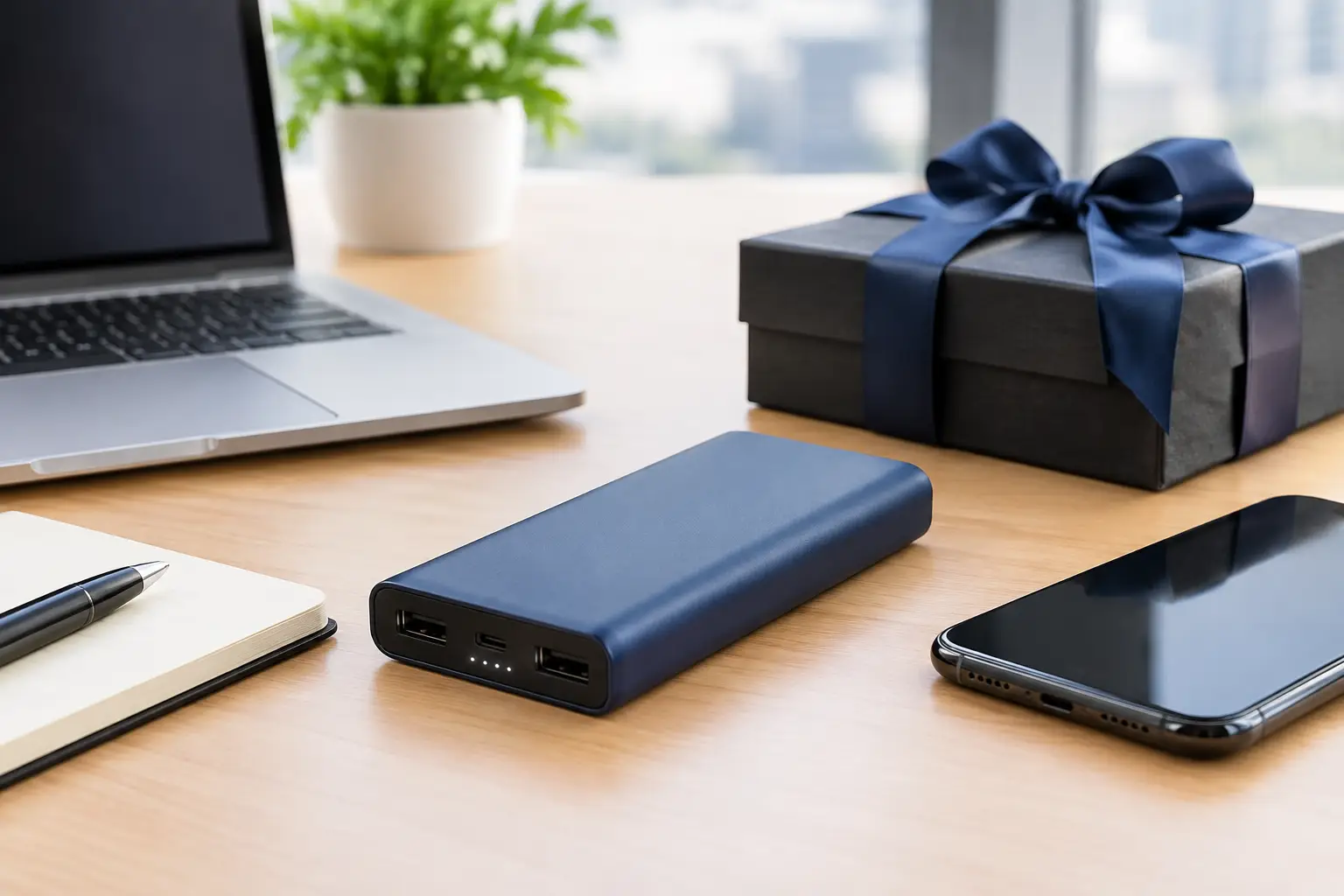
A power bank with your logo can be one of the most useful corporate gifts in a busy employee, client, or event attendee’s bag. It can also become a brand risk if it overheats, fails after a few charges, or arrives without the documentation required for safe transport. So, are branded power banks safe? They can be, provided the product itself is properly tested, sourced from a reliable manufacturer, and customized without compromising its construction.
For corporate buyers, the question is not simply whether a power bank works on arrival. It is whether it will perform reliably across hundreds or thousands of units, meet relevant safety expectations, travel appropriately, and reflect well on the organization whose name is printed on it.
Are Branded Power Banks Safe When Customized?
Adding a logo does not inherently make a power bank less safe. In most cases, branding is applied to the outer casing through printing methods such as UV printing, pad printing, laser engraving, or full-color digital printing. A competent customization process should leave the battery cells, circuit board, ports, and protective housing untouched.
The concern is the quality of the base product and how responsibly it is handled during production. A poorly made unit may use lower-grade lithium-ion cells, inadequate insulation, or unreliable charging circuitry. It may still look polished once a logo is added. That is why a low quote alone should never be the deciding factor for electronic corporate gifts.
Customization also needs practical review. Artwork should not cover charging ports, indicator lights, model information, or safety labels. If a design requires a wrap or a large print area, the supplier should confirm that it will not interfere with heat dissipation, controls, or required markings. These are small details, but they separate a thoughtful branded product from one that creates unnecessary support issues after distribution.
What Makes a Power Bank Safe?
A safe power bank is designed to manage the normal risks associated with rechargeable lithium batteries. Its internal protection system should help prevent overcharging, over-discharging, short circuits, overcurrent, and overheating. The casing should also protect the cells from everyday bumps and pressure inside a backpack or laptop bag.
For business orders, ask suppliers how they verify safety rather than accepting general claims such as “premium quality” or “certified.” Reliable suppliers can explain the specifications and provide relevant product documentation for the exact model being quoted.
Look for the right test reports and certifications
The documentation needed can vary by destination, product type, and shipping method. Still, several standards are particularly relevant when evaluating promotional power banks:
- UN38.3 confirms that lithium batteries have passed transport-related testing. This is especially important for air shipments and international fulfillment.
- IEC 62133 is a widely recognized battery safety standard for portable sealed secondary cells and batteries.
- UL 2054 is a commonly referenced safety standard for household and commercial battery packs in the United States.
- FCC compliance relates to electromagnetic interference requirements for electronic devices sold in the U.S.
- RoHS compliance addresses restrictions on certain hazardous substances in electrical and electronic products.
No single document answers every safety question. UN38.3, for example, is essential for shipping but is not a complete assurance of long-term product quality. The strongest approach is to review a combination of applicable test reports, factory quality controls, product samples, and the supplier’s willingness to answer specific questions.
Check the capacity and output claims
Capacity is normally stated in milliamp-hours, or mAh. A 10,000 mAh power bank is a popular corporate gifting option because it offers meaningful day-to-day charging while remaining compact enough for events, welcome kits, and client packs. But the rated capacity does not translate directly into the same amount of usable charge for every phone. Energy is lost during voltage conversion and charging.
Be cautious when an unusually slim or inexpensive unit claims very high capacity. The physical size, weight, battery chemistry, and price should make sense together. A supplier should be able to provide the rated battery capacity, output wattage, input options, number of ports, and whether the unit supports USB-C Power Delivery or other fast-charging protocols.
Higher output is valuable for recipients who charge newer smartphones, tablets, or accessories. However, compatibility matters more than headline numbers. A well-built 10,000 mAh unit with dependable USB-C charging will generally create a better brand experience than a questionable high-capacity model that charges slowly or inconsistently.
Questions to Ask Before Placing a Corporate Order
For an employee appreciation campaign or event giveaway, purchasing teams need clear answers before artwork approval and mass production. Start by confirming whether the quoted model is a proven product or a newly sourced substitute. Product substitutions are a common cause of inconsistent quality in large orders.
Ask for current test reports that match the model and battery configuration. Request a physical pre-production sample when timing allows, particularly for premium client gifts, high-volume campaigns, or products with a large printed area. Test the sample with common recipient devices, check the fit of the charging cable, inspect the print quality, and use the unit through several charging cycles.
It is also sensible to confirm how the product will be packed. Individual boxes should protect the unit from scratches and impact, while printed instructions should identify capacity, input and output ratings, charging guidance, and basic safety precautions. For event distribution, consider including a suitable cable if the selected product does not have an integrated one. A power bank is less useful when recipients need to search for the right connector.
Finally, discuss delivery conditions early. Lithium battery shipments may require specific labeling, declarations, carton limits, or carrier arrangements. If your campaign involves sending gifts to multiple offices or individual recipients, the fulfillment plan should account for battery shipping requirements from the start rather than after the goods are produced.
Safe Use Guidance Is Part of Good Gifting
Even a compliant, well-made power bank should be used sensibly. The most useful recipient guidance is straightforward: use a suitable cable and charger, avoid leaving the unit in direct heat, keep it dry, and stop using it if the casing swells, cracks, becomes unusually hot, or emits an odor.
Avoid distributing units with no instructions, no traceable model information, or no clear supplier support. A corporate gift represents the organization long after an event ends. If a recipient has a problem, there should be a practical route for the organizer to identify the product batch and seek assistance.
This does not mean every giveaway needs an elaborate warranty program. It means choosing a supplier that takes ownership of specification checks, print placement, sample approval, packing, and delivery. For organizations managing multiple event details, that support reduces the chance of small oversights becoming last-minute problems.
Choosing the Right Power Bank for the Occasion
The safest choice is not always the most expensive model. It depends on the audience and use case. For large conference giveaways, a compact, certified 5,000 mAh unit may be practical, easy to carry, and easier to purchase within budget. For employee onboarding kits, sales teams, executive gifts, or travel-focused campaigns, a higher-capacity 10,000 mAh or 20,000 mAh model with USB-C output may better match the recipient’s needs.
Appearance matters as well. A clean logo on a durable metal or quality ABS casing often feels more professional than an oversized design on a low-cost unit. Consider the intended branding lifespan: event dates and campaign slogans can be effective for a one-time activation, while a subtle company logo is more likely to stay in daily use.
At Global Asia Printings, power bank selection can be treated as part of the wider merchandise plan, alongside packaging, apparel, lanyards, bags, and event requirements. This helps teams align the product with the campaign budget, timeline, and recipient profile rather than selecting an electronic gift in isolation.
A branded power bank should give recipients a useful charge and give your team confidence in every unit handed out. Start with a tested model, verify the documentation, approve a real sample, and choose a supplier prepared to guide the process from specification to delivery.