


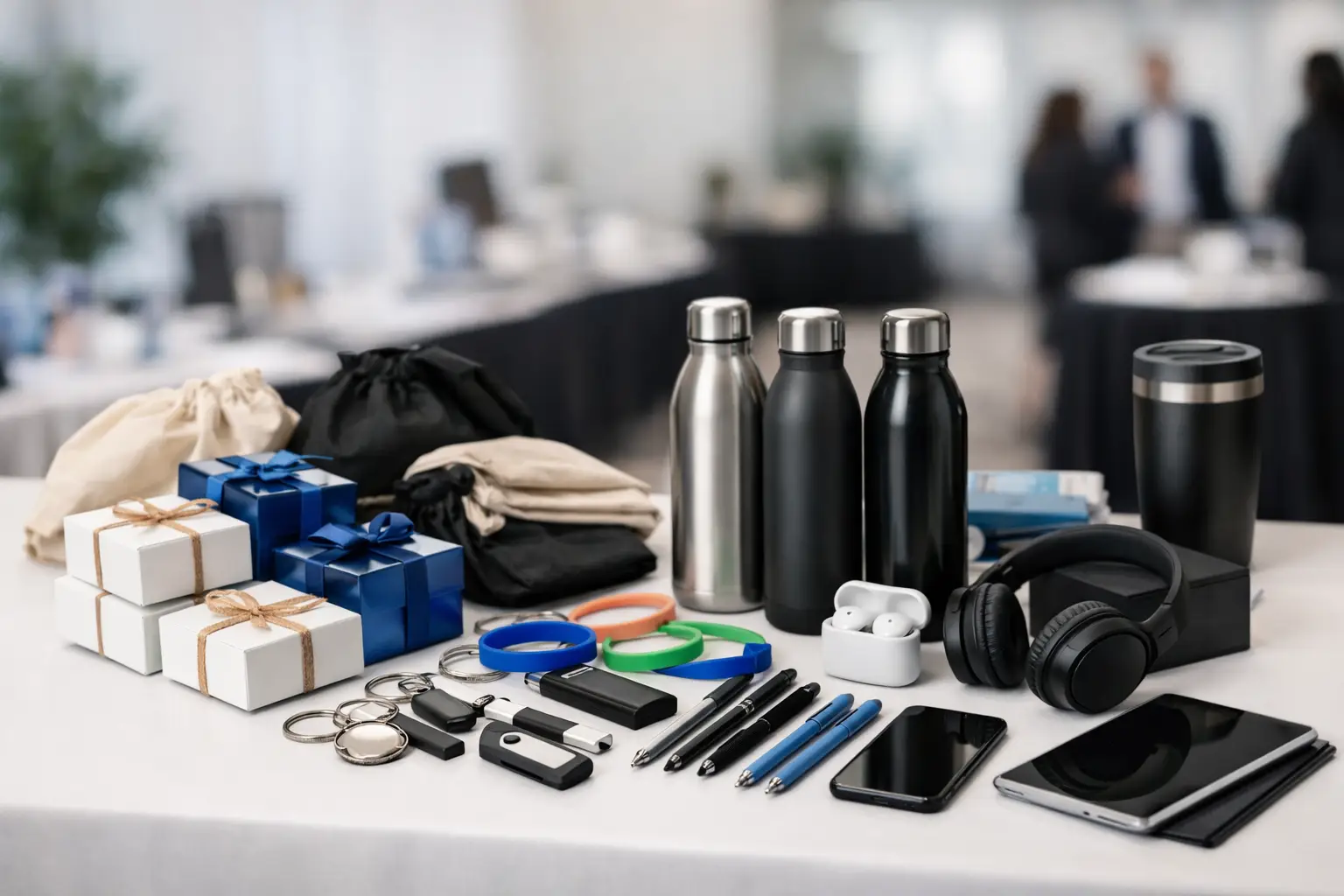
A registration list might say 300 attendees, but ordering 300 branded giveaways is rarely the right answer. When clients ask how many giveaways needed for an event, the useful answer starts with who will receive them, how the item will be distributed, and whether the giveaway is meant to drive traffic, reward participation, or simply leave a professional impression.
For corporate events, the goal is not to hand out the maximum number of items. It is to have the right quantity of the right item at the right moment, without running short or paying to store cartons of unused merchandise afterward. A practical quantity plan protects your budget and makes the activation feel organized.
How Many Giveaways Needed? Start With Distribution
The number of invited guests is only one input. First, define the distribution model. A welcome gift for every registered conference participant needs a very different quantity from a premium item offered only to qualified booth visitors or contest winners.
For attendee gifts, begin with confirmed registrations rather than invitations sent. Then adjust for the expected show-up rate. An internal company town hall may have a high attendance rate, while an open networking event or public roadshow may vary much more widely. If 500 people register and the organizer expects 80% attendance, the working estimate is 400 attendees, not 500.
Next, decide whether each person receives one item. This sounds obvious, but event teams often plan multiple touchpoints: a lanyard at registration, a tote bag with collateral, and a small redemption gift at the booth. Each touchpoint needs its own quantity estimate. Combining all items into one general number is how one station ends with excess stock while another runs out before lunch.
For a standard registration gift, a reliable starting formula is:
Confirmed expected attendees + 5% to 10% operational buffer
The buffer covers walk-ins, replacement items, VIPs, staff who need matching items, and simple counting errors. For 400 expected attendees, an order of 430 to 440 units is usually sensible. The correct buffer depends on the event setup. A tightly controlled, ticketed dinner may only need 5%, while a busy public event with on-site registration may justify 10% or more.
Match the Quantity to the Giveaway Purpose
A giveaway should have a job. Quantity planning becomes much easier when that job is clear.
Welcome and appreciation gifts
These gifts are intended for everyone attending: employee appreciation packs, seminar notebooks, event T-shirts, branded tote bags, or conference lanyards. Order based on expected attendance plus a modest buffer. Do not forget speakers, hosts, organizers, and event crew if they are meant to receive the item.
Apparel requires additional planning because sizes create another layer of risk. If shirts are distributed on-site, estimate the size curve from past orders or pre-event registration data. Ordering a flat quantity by size can leave you with too many extra-small shirts and no large sizes by midday. When possible, collect sizes in advance or use a redemption system for higher-value apparel.
Booth traffic giveaways
At an exhibition or trade show, not every visitor needs the same item. A small, useful branded giveaway such as a pen, notebook, luggage tag, or phone accessory can support broad awareness and encourage visitors to stop. Premium items should be reserved for meaningful conversations, booked meetings, demonstrations, or qualified leads.
Estimate booth giveaways from realistic footfall, not total event attendance. If an exhibition expects 5,000 visitors, it does not mean your booth will speak with 5,000 people. A booth team may reasonably engage 10% to 25% of attendees depending on location, event relevance, staffing, and attraction. For a two-day show expecting 5,000 visitors, planning 750 to 1,000 small giveaway units may be appropriate if the goal is wide engagement. A premium gift quantity may be only 100 to 250 units.
Contest, redemption, and activity rewards
Live printing, spin-and-win mechanics, workshops, games, and social media redemptions need a capacity-based calculation. Work backwards from the number of people the team can serve per hour.
For example, if a live printing station can personalize 20 tote bags an hour over a six-hour activation, maximum production capacity is 120 bags. Ordering 500 blank totes would not improve the guest experience if only 120 can be printed. In this case, prepare materials for the production capacity plus a small contingency, and make the redemption rules clear before the queue forms.
Client and executive gifts
Premium corporate gifts are less about volume and more about precision. Build the list by recipient name and add only a small reserve for late additions, relationship managers, or replacement packaging. For 80 identified clients, 85 to 90 units is often safer than 120. Overordering costly gifts can create unnecessary spend and weaken the intended sense of exclusivity.
Use a Three-Tier Giveaway Plan
Many events work best with three giveaway levels rather than one item for everyone. This approach lets organizers manage cost while matching the item to audience value.
The first tier is a high-volume, lower-cost item for general visitors. The second is a better-value item for people who complete a desired action, such as attending a product demo, joining a mailing list, or participating in an activity. The third is a premium gift for VIPs, clients, speakers, or qualified prospects.
This structure prevents an all-or-nothing decision. Instead of buying 1,000 expensive items for every passerby, a team might prepare 800 branded pens, 300 insulated tumblers, and 75 premium gift sets. The event still feels generous, but the budget is directed toward the audiences that matter most.
Build the Budget Before You Confirm the Quantity
Quantity and unit cost move together. A larger order may lower the price per item, but it can still cost more overall and create waste. The best purchase quantity is not always the biggest quantity break.
Set a total giveaway budget, then allocate it by objective. Consider the product itself, customization method, packaging, fulfillment, delivery, event staffing, and any on-site activation requirements. A printed T-shirt may have a different cost structure from a laser-engraved bottle or a live-personalized canvas pouch.
Also consider perceived value. A useful, well-branded item that fits the audience often performs better than a large volume of novelty products. For a financial services seminar, a quality notebook and pen may suit the setting. For a fitness challenge, a quick-dry shirt, towel, or water bottle may be more relevant. The giveaway should reinforce the event experience, not feel like leftover inventory.
Avoid the Most Common Quantity Mistakes
The first mistake is ordering based on the maximum possible audience. Invitation numbers are not attendance numbers, and attendance is not engagement. This approach often leaves organizations with boxes of dated event merchandise after the program ends.
The second is using the same item for every audience segment. Visitors, employees, sponsors, speakers, and high-value clients may all be present, but they do not necessarily need the same giveaway. Tiered distribution is more efficient and usually more memorable.
The third is forgetting operational stock. A few spare lanyards, badges, T-shirts, or bags are useful. A large, unplanned surplus is not. Assign one person to track distribution during the event, especially for limited or premium merchandise. Simple count sheets or redemption tokens can prevent a giveaway table from becoming unmanageable.
Finally, do not order before confirming artwork, lead time, and delivery requirements. A product that fits the budget but cannot be produced and delivered in time is not a solution. Early quantity planning gives your supplier room to recommend alternatives when stock, printing methods, or event schedules change.
A Practical Event Quantity Example
Consider a company hosting a product launch for 350 registered guests. Based on previous events, it expects 85% attendance, or about 298 people. The team plans a welcome tote for attendees, a limited-edition bottle for guests who complete a product demonstration, and premium gift boxes for 40 invited clients.
For the tote bags, order approximately 325 units to cover expected attendance, staff needs, and a 9% buffer. For bottles, estimate that 60% of attendees will complete the demonstration, or about 180 people. Ordering 200 bottles gives the team enough capacity without encouraging uncontrolled distribution. For client gift boxes, prepare 45 units, with five held back for unexpected VIP additions or replacements.
That plan is more purposeful than ordering 350 of every item. It also makes it easier for staff to explain the giveaway experience and maintain stock throughout the event.
The most dependable answer to how many giveaways are needed is a quantity tied to behavior, not guesswork. Start with expected attendance, separate each distribution point, add a sensible buffer, and reserve premium merchandise for moments that deserve it. With the right planning and a capable production partner, your giveaways can support the event instead of becoming another post-event logistics problem.