


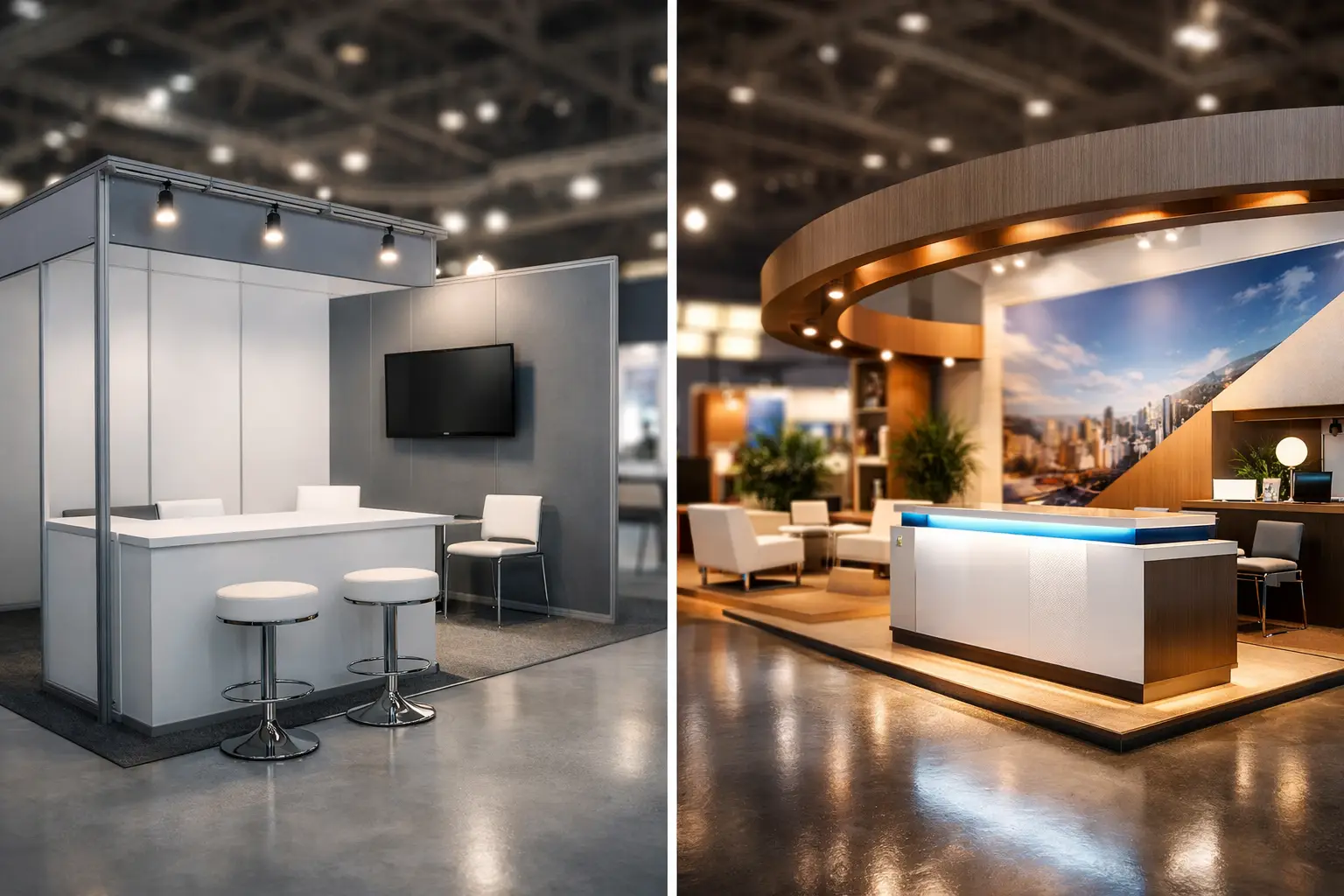
A booth has only a few seconds to tell visitors whether your team is worth approaching. That is why the rental booth versus custom booth decision is more than a question of walls, counters, and graphics. It affects your event budget, setup timeline, visitor experience, and how consistently your brand appears across every touchpoint.
For marketing teams, event planners, and procurement coordinators, the right answer depends on the event’s purpose. A one-time industry exhibition calls for a different investment than a roadshow, product launch, or annual trade show where the same branded presence will be used repeatedly. The practical choice is the one that supports your objectives without creating unnecessary storage, production, or logistics costs.
Start With the Event’s Job
Before comparing booth types, define what the booth must do. Is it meant to generate leads, demonstrate a product, host meetings, distribute merchandise, or create a social-media-ready activation? A compact booth for collecting inquiries has very different requirements from a space designed for live printing, samples, private conversations, or a full product display.
Also consider how often the concept will be used. If your organization is testing a new event category or attending one show this year, flexibility may matter most. If your team exhibits several times annually and needs a recognizable setup each time, ownership and repeatability may carry more value.
Your available footprint matters as well. Many organizers provide standard shell-scheme spaces with fixed dimensions and venue rules. Others offer bare space that gives exhibitors more freedom, but also places more responsibility on them for flooring, lighting, electrical planning, permits, installation, and teardown. A good booth plan works with the event environment instead of fighting it.
Rental Booth Versus Custom Booth: The Core Difference
A rental booth uses modular structures, display systems, furniture, counters, lighting, and other elements supplied for a specific event period. It can be adapted with branded graphics, printed backdrops, display panels, and selected accessories. The structure returns after the event, while the branding components may be replaced or retained depending on the project.
A custom booth is built or purchased for your organization’s continued use. It can include tailored layouts, unique shapes, integrated storage, fitted displays, custom fabrication, and brand-specific features. It is designed around your visual identity and event requirements rather than around a standard modular framework.
Neither option is automatically better. Rental is often the smarter commercial decision when flexibility, speed, and lower upfront spending are priorities. Custom is often the stronger choice when a brand has a recurring exhibition program and needs a distinctive, controlled experience that can be deployed repeatedly.
When a rental booth is a strong fit
Rental booths work particularly well for first-time exhibitors, short-term campaigns, conferences in multiple cities, and events where the booth size changes from year to year. They also reduce the need to store large structures between shows, which can be useful for organizations without warehouse capacity or a dedicated events team.
The modular nature of rental systems does not mean the booth has to look generic. Well-planned graphics, coordinated furniture, strong product presentation, digital screens, branded giveaways, and clear visitor flow can make a standard footprint feel intentional and professional. The key is to use the available structure efficiently instead of treating graphics as an afterthought.
Rental can also simplify last-minute changes. If an organizer adjusts your allocated space or your campaign messaging changes before the event, it is usually easier to revise printed panels and modular components than to alter a fully fabricated build.
When a custom booth earns its cost
A custom booth makes sense when your booth itself is part of the brand experience. This could include a premium product showcase, an experiential activation, a live demonstration area, or a hospitality-focused space for key clients. Custom fabrication provides more control over how visitors enter, move through, interact with, and remember the space.
It is especially valuable for organizations that attend several major events with similar space requirements. Over time, reusing owned elements can reduce the repeated rental charges associated with large displays. A custom asset may also give your team consistent brand recognition across events, provided it is maintained, transported, and updated properly.
The trade-off is commitment. Once built, a custom booth may be less flexible if your event footprint changes, your product lineup evolves, or your brand identity is refreshed. It also requires storage, inventory management, transportation, and repair planning. Those ongoing responsibilities should be included in the decision, not added as a surprise after production is complete.
Compare the Full Cost, Not Just the Quote
A rental quote often looks more affordable at first because it avoids a large upfront fabrication expense. For a single event, that may be exactly the advantage you need. However, evaluate the complete project cost: design, printed graphics, rental structures, furniture, lighting, installation, dismantling, freight, venue access, electrical work, and any damage or overtime charges.
For a custom booth, the initial quote should cover design development, fabrication, graphics, finishing, packing, transport, installation, dismantling, storage, and future modifications. A lower production price is not necessarily lower cost if the booth requires expensive handling at every event or cannot fit into typical venue spaces.
A useful way to assess the decision is to compare projected costs across two or three years. Estimate the number of events, expected booth sizes, likely redesigns, and storage needs. If your exhibition calendar is irregular, rental usually protects your budget. If it is consistent and high-volume, custom ownership may become more economical over time.
Lead Time and Execution Risk Matter
Event deadlines have a way of arriving faster than expected. Rental booths generally offer shorter planning windows because the core structure already exists. The production focus shifts to artwork, layout, printed panels, and event coordination. This can be a major advantage when event confirmation comes late or internal approvals take longer than planned.
Custom booths need more lead time for design approval, engineering, fabrication, finishing, quality checks, and logistics. This is not a reason to avoid them. It is a reason to begin early and work with a supplier that can manage the full production schedule. Rushing a custom build can create avoidable compromises in finish quality, fit, safety, or onsite installation.
For either approach, provide final artwork early, confirm venue regulations, and identify practical requirements such as power points, internet access, storage, product displays, and staffing areas. A visually attractive booth can still underperform if the team has nowhere to keep inventory, charge devices, or speak privately with prospects.
Brand Impact Comes From More Than the Structure
Visitors do not judge a booth by fabrication alone. They notice whether the messaging is clear, whether staff apparel is coordinated, whether giveaways feel relevant, and whether the experience is easy to understand. A rental booth with excellent branding and well-organized engagement can outperform a costly custom booth with unclear messaging.
Use the booth as a connected campaign space. Match the key visual to your brochures, product samples, uniforms, lanyards, tote bags, and promotional items. If the event includes a hands-on activity, such as live apparel or merchandise printing, make the process visible. People are naturally drawn to experiences that show how a product is made or personalized.
This is where an end-to-end partner can reduce coordination risk. Global Asia Printings can support booth setup alongside printed graphics, custom apparel, corporate gifts, and event merchandise, helping teams maintain one brand standard rather than managing several separate suppliers.
Choose Based on These Event Scenarios
A rental booth is usually the better fit when you are attending a single event, testing a new audience, working within a tightly controlled budget, or expecting different booth sizes across venues. It gives you a professional presentation without tying up capital in an asset that may sit unused.
A custom booth is usually the better fit when you exhibit frequently, require specialized zones for demonstrations or meetings, need a distinctive premium presence, or have enough internal planning capacity to manage storage and reuse. It creates stronger control, but that control comes with operational responsibility.
A hybrid option can be the most practical answer. Many organizations invest in reusable custom elements, such as a branded reception counter, display plinths, lightboxes, or a signature backdrop, then combine them with rented walls, furniture, and lighting for each venue. This approach preserves brand recognition while allowing the layout to scale up or down.
Build the Booth Around What Happens Next
The best booth decision supports the action you want after a visitor stops. If the goal is lead capture, make the sign-up point obvious and keep the counter clear. If the goal is product trial, leave room for staff to demonstrate without blocking the aisle. If the goal is employee or client engagement, plan enough space for personalization, gift collection, and easy movement.
Choose the booth format that lets your team show up prepared, on-brand, and ready to have useful conversations. A practical setup, clear graphics, and dependable onsite execution will do more for event results than an oversized structure chosen only to look impressive.