


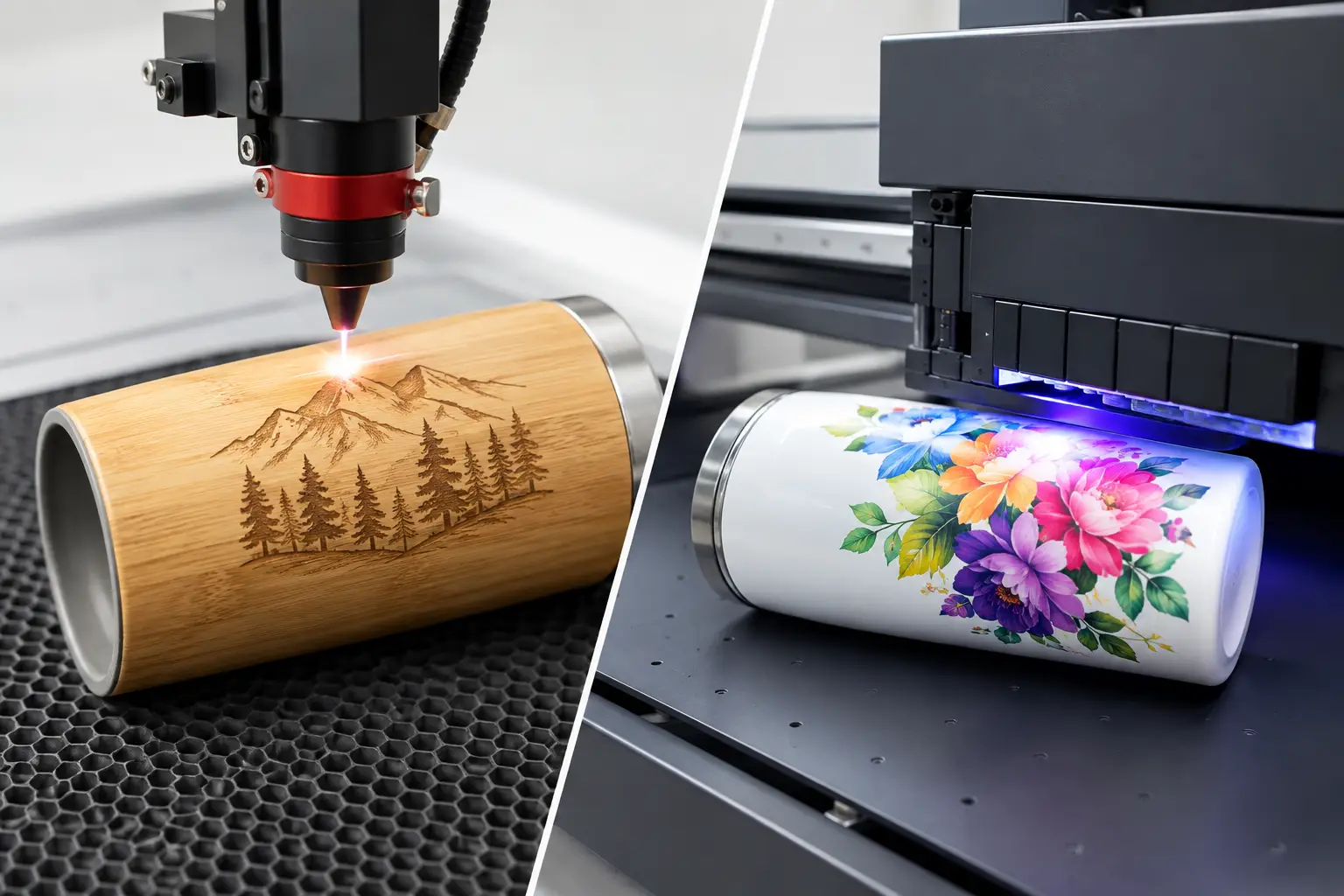
A logo on a metal tumbler can look understated and premium, or bright and highly visible from across an event booth. The difference often comes down to laser engraving versus UV printing. Both methods create professional branded merchandise, but they produce very different results in color, texture, durability, and cost. Choosing correctly at the start prevents a common corporate ordering problem: receiving attractive products that do not quite match the campaign, audience, or brand guidelines.
For marketing teams, HR departments, procurement buyers, and event organizers, the right method depends less on which process is “better” and more on the product, artwork, intended use, and deadline. A giveaway for a high-energy product launch has different requirements than an executive appreciation gift or a staff milestone award.
How the Two Customization Methods Work
Laser engraving uses a focused laser to remove or alter a thin top layer of a material. On coated metal drinkware, for example, the laser removes the colored coating to reveal the stainless steel underneath. On wood, bamboo, leatherette, acrylic, or anodized aluminum, it creates a permanent mark with a refined, tactile appearance.
The result is usually one color because the engraving reveals the material beneath the surface. That limitation is also part of its appeal. A clean logo, name, monogram, or simple line-art design can look polished without competing with the product itself.
UV printing applies specially formulated ink directly onto an item, then cures it immediately with ultraviolet light. The cured ink sits on the product surface and can reproduce full-color artwork, gradients, small details, and photographic elements. It is commonly used for power banks, notebooks, acrylic awards, phone accessories, packaging, pens, and flat or gently curved gift items.
Unlike engraving, UV printing gives brand teams much more freedom with color. It can match a corporate palette, include campaign graphics, or display multiple logos in one design. Depending on the item and artwork, it may also create a slightly raised finish that adds visual interest.
Laser Engraving Versus UV Printing: The Key Differences
The most useful comparison is not simply permanent versus colorful. Both can be excellent choices when they are applied to suitable products and handled with proper artwork preparation.
| Consideration | Laser Engraving | UV Printing | | — | — | — | | Best visual effect | Premium, subtle, material-led | Bright, colorful, graphic-led | | Color capability | Usually single-color | Full color, gradients, detailed art | | Surface feel | Engraved into or through a surface | Ink printed on the surface | | Best artwork | Logos, names, line art, simple marks | Brand palettes, illustrations, photos, complex layouts | | Common products | Tumblers, metal pens, wood gifts, leatherette | Tech gifts, notebooks, acrylic, packaging, flat merchandise | | Typical brand impression | Executive, durable, understated | Promotional, energetic, highly visible |
Color and Brand Visibility
UV printing is generally the stronger option when color is non-negotiable. If a logo relies on a specific blue, a multicolor icon, or a campaign illustration, engraving cannot reproduce it in the same way. UV printing can make the design immediately recognizable, which is valuable for trade show giveaways, product launches, school events, and consumer-facing promotions.
Laser engraving works best when the product itself provides the visual character. A black insulated bottle with a crisp silver logo, a bamboo charging pad with a clean engraved mark, or a leatherette portfolio with an employee name can feel considered and high-value. The branding is visible, but it does not overwhelm the item.
It is worth considering viewing distance. UV-printed artwork tends to attract attention from a distance. Engraved artwork often makes a stronger impression when held and examined closely. For an event counter where merchandise must catch the eye, color may matter more. For a client gift intended for daily desk use, an engraved finish can feel more appropriate.
Durability and Everyday Use
Laser engraving is often preferred for items that will be handled frequently, washed, carried, or used for years. Because the mark is etched into or through the surface rather than printed on top, it is less likely to fade, peel, or scratch under normal use. This makes it a practical choice for metal drinkware, tools, keychains, nameplates, and durable executive gifts.
UV printing is durable when the right ink, curing process, and product surface are used, but it remains a surface print. Abrasion, sharp objects, harsh cleaning chemicals, and repeated friction can affect it over time. That does not make UV printing unsuitable for corporate merchandise. It simply means product selection and expected use should guide the decision.
For example, a UV-printed wireless charger or desk organizer can perform well in an office environment. A bottle likely to be placed in a bag with keys, washed often, and taken outdoors may be a better candidate for laser engraving. A dependable supplier should advise on these real-world use cases rather than recommending one method for every item.
Artwork Requirements and Design Flexibility
Engraving rewards restraint. Bold logos, vector artwork, readable type, and sufficient spacing between elements produce the cleanest result. Very fine lines, tiny text, dense patterns, and complex shading may lose clarity, especially on small merchandise such as pens or keyrings.
UV printing can accommodate more detailed artwork, but a full-color file is not automatically print-ready. Small text still needs to be legible at the final print size, and colors may appear differently on dark, textured, transparent, or curved surfaces. White ink may be needed as a base layer on darker products so colors remain bright.
A practical approach is to begin with the actual item dimensions, not the original artwork file. A design that works beautifully on a presentation slide may need adjustment before it fits a 2-inch-wide power bank or a narrow pen barrel. Confirming the print area, orientation, and artwork proof before production reduces avoidable surprises.
Match the Method to the Merchandise and Occasion
For premium employee service awards, client appreciation gifts, executive onboarding kits, and long-term recognition items, laser engraving often supports the intended message. It gives a permanent, less promotional look that suits names, milestone dates, and company logos. It is particularly effective on stainless steel, bamboo, wood, leatherette, and certain coated metal products.
For roadshows, exhibitions, open houses, retail activations, and campaign giveaways, UV printing can deliver stronger visual impact. Full-color logos, event themes, QR-style graphics where appropriate, and sponsor branding are easier to present consistently across merchandise. Acrylic plaques, compact tech accessories, notebooks, and display pieces are common applications.
There are also occasions where using both methods is the right answer. A company may select engraved tumblers for VIP guests while choosing UV-printed power banks or notebooks for a larger event audience. The merchandise remains aligned with one campaign, while the finish matches the perceived value and purpose of each item.
Budget, Quantity, and Production Planning
Neither method is automatically the lower-cost choice. Pricing depends on the product material, decoration area, artwork complexity, order quantity, setup needs, and whether names or individual data are required. A simple engraved logo may be efficient for a large run of compatible items. A complex full-color UV design may be more economical than trying to simplify a brand identity into a single engraved mark.
Variable personalization is another factor. Engraving individual names on a set of awards, bottles, or portfolios can create a high-value experience, but each name must be checked carefully before production. UV printing can also personalize items, particularly where names are combined with colorful artwork, though production planning remains essential.
Lead time should be discussed early, especially for event dates. Material availability, artwork approval, sample requirements, and finishing all affect the schedule. If an order includes apparel, lanyards, gifts, booth graphics, and on-site event printing, coordinating the items through one production partner can reduce last-minute gaps and mismatched branding. Global Asia Printings helps clients assess product choices, decoration methods, budgets, and delivery requirements as one connected project.
Questions to Settle Before You Approve Production
Before selecting a decoration method, confirm four practical details: the product material, the final artwork and colors, how the item will be used, and the required delivery date. These answers usually make the decision much clearer.
Ask to see a digital proof that shows the real print area and placement. For high-value gifts, custom colors, or a large campaign, a physical sample can also be worthwhile. It gives stakeholders a chance to assess color, texture, readability, and overall presentation before the full order proceeds.
The best branded product is not the one with the most elaborate decoration. It is the one that carries your logo in a way people will notice, use, and remember. Start with the message you need the item to deliver, then choose the finish that lets that message come through clearly.