


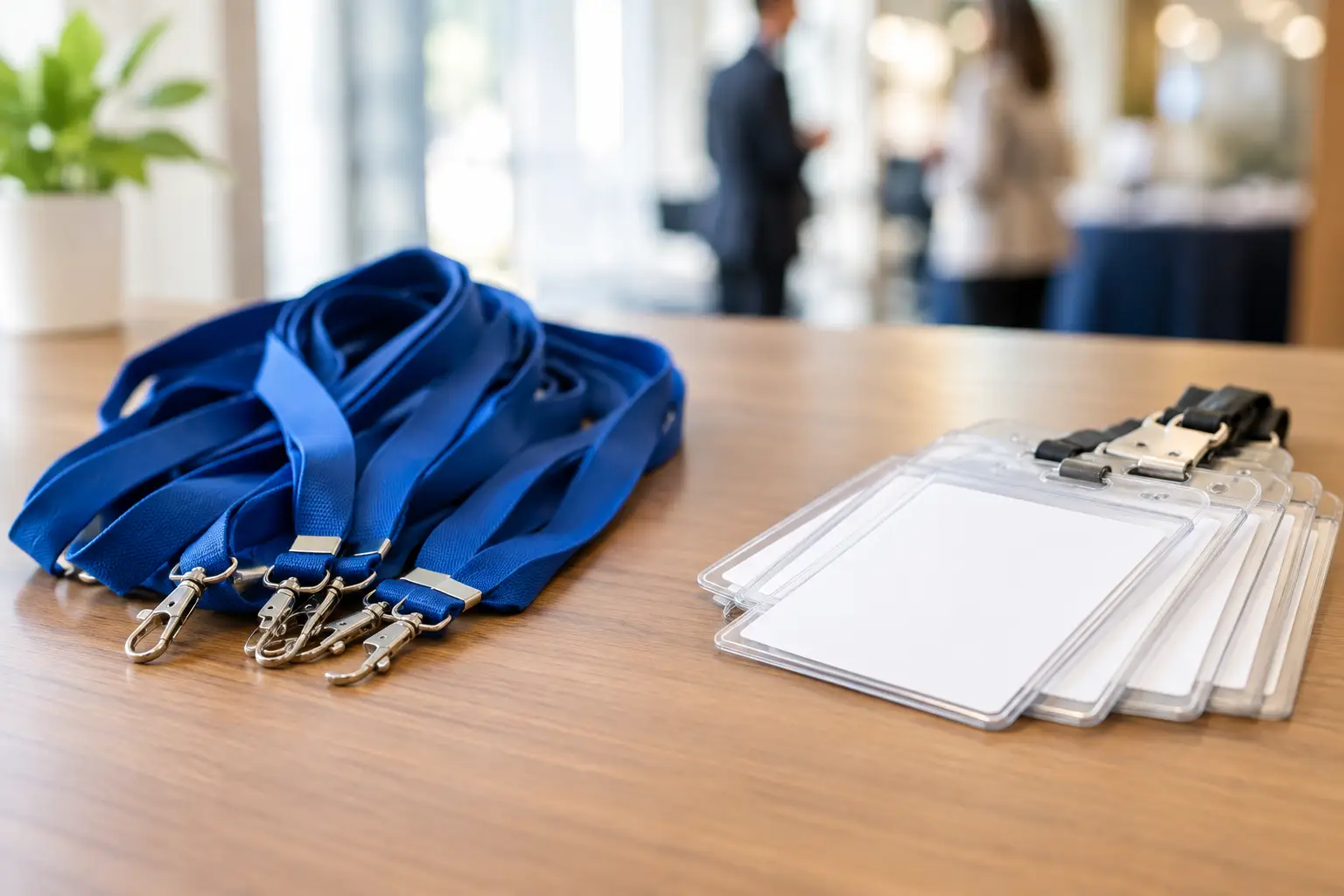
At a busy registration desk, the difference between a lanyard and a name badge becomes obvious quickly. Attendees need to be identified, staff need access where appropriate, and your brand needs to look organized from the first handshake. In the lanyards vs name badges decision, the strongest answer is often not one or the other. A lanyard carries the credential; the name badge provides the information people need to see.
For corporate events, workplaces, schools, exhibitions, and visitor programs, choosing the right identification setup affects security, networking, staff efficiency, and brand presentation. The best format depends on where it will be worn, how long it will be used, and what it needs to communicate.
Lanyards vs Name Badges: The Key Difference
A lanyard is a cord, strap, or ribbon worn around the neck to hold an item such as an ID card, event pass, access card, keys, or badge holder. It is primarily the carrying method, although custom printing turns it into a visible branding surface.
A name badge is the credential itself. It may display a person’s name, company, department, role, event category, access level, or QR code. It can be a paper insert inside a holder, a rigid plastic card, a clip-on badge, or a reusable magnetic badge.
This distinction matters when planning an order. Asking for “event badges” without confirming how guests will wear them can result in incomplete supplies. Conversely, ordering branded lanyards without considering badge size, holder orientation, or attachment type can create a poor fit on event day.
For most conferences and exhibitions, a printed lanyard plus a personalized badge is the practical standard. For an office recognition program or a short internal meeting, a clip-on or magnetic name badge may be the better choice.
When Custom Lanyards Are the Better Choice
Lanyards work best when people need hands-free, highly visible identification throughout the day. They are particularly useful at trade shows, conferences, school events, campus orientations, facility tours, and large corporate functions where attendees move between rooms or queues.
A neck-worn credential is easier for security teams and event staff to spot from a distance. It also avoids the common problem of adhesive badges falling off clothing or becoming hidden under a jacket. For multi-day events, lanyards are more comfortable and reliable than repeatedly applying disposable stickers.
Custom printed lanyards also give your organization repeated brand exposure. Your logo, event name, sponsor message, or department identifier remains visible while attendees walk through the venue. In a crowded exhibition hall, this helps staff look coordinated and gives visitors a quick visual cue about who is representing your company.
The material and attachment should match the setting. Polyester lanyards are a popular, cost-conscious option for large runs. Woven lanyards offer a more textured, premium finish, while tubular styles provide a softer feel for longer wear. A swivel hook is a common choice for badge holders, while breakaway safety clips are worth considering for schools, production environments, and situations where the lanyard could catch on equipment.
There are trade-offs. Lanyards can feel excessive for a small boardroom meeting, and they may not suit formal client-facing settings where a discreet badge looks more polished. They also require a credential or holder to do their job, so they are not a replacement for properly designed identification.
When Name Badges Are the Better Choice
Name badges are the better standalone option when immediate personal recognition matters more than event access. Think of retail associates, hospitality teams, front-desk staff, sales representatives, workshop facilitators, and volunteers working in a fixed location.
A professional name badge helps customers know who to approach without making the wearer look like an event attendee. Reusable badges are especially suitable for organizations with stable teams, because names and job titles can be presented consistently across uniforms and locations.
For one-time networking sessions or small internal gatherings, adhesive name badges can be simple and economical. They work well when guests are seated for most of the session and security controls are minimal. However, they are less durable, can wrinkle on some fabrics, and often look worn by the end of a long program.
Magnetic badges offer a cleaner alternative to pins and clips, particularly for formal wear and staff uniforms. They are convenient, but they cost more than temporary options and may not be appropriate for people with certain medical devices. Clip-on badges are broadly practical, though they can pull on delicate fabric or rotate while worn.
Choose Based on the Job the Credential Must Do
The right identification product starts with function, not decoration. Before selecting materials or print finishes, decide whether the item needs to identify people, control entry, promote a brand, support networking, or do all four.
For a conference, the badge should be readable at a conversational distance. Include the attendee’s name prominently, with company and role below if networking is a key goal. Use color bands, icons, or clearly labeled categories for speakers, exhibitors, VIPs, media, staff, and general attendees. A lanyard then keeps the badge visible and easy to scan.
For a workplace, consider how frequently staff will wear the identification. A durable plastic name badge may be ideal for customer-facing teams, while an ID card on a retractable reel or lanyard may better suit employees who need to tap into secured areas. If staff work around machinery or active equipment, safety should guide the attachment choice.
For exhibitions, make the badge work harder. It can include a QR code for lead capture, a hall or zone indicator, appointment details, or sponsor visibility. Pair it with a lanyard color that matches your booth design or team apparel for a more coordinated presence.
Branding and Readability Must Work Together
It is tempting to fill a small badge with logos, taglines, partner marks, and program details. But a badge that cannot be read quickly does not serve attendees or staff. The name should remain the visual priority, followed by the information someone needs to act on, such as company, role, or access category.
Your lanyard offers more room for repeated logo placement and event branding. That makes it a useful place for sponsor visibility, web addresses, campaign themes, or department names, without crowding the credential itself. Keep text sufficiently large and use colors with enough contrast to remain legible under venue lighting.
Consistency matters across the full event kit. When lanyards, badges, staff shirts, directional signage, and booth graphics share a clear visual system, guests can find help faster and your organization appears prepared. This is particularly valuable for large events with multiple vendors, rooms, and attendee types.
Plan Quantities, Personalization, and Timing Early
Badge projects have two different production needs: the branded base items and the variable attendee information. Lanyards can usually be produced in advance based on projected attendance, while personalized badge inserts may need to remain flexible until registration numbers are final.
Order a sensible contingency quantity for late registrations, replacements, walk-ins, and staff changes. For an event with multiple access levels, keep spare blank badges and appropriate holders available at the registration desk. It is far easier to manage a controlled overage than to explain why a confirmed guest cannot receive a credential.
Also confirm the physical specifications before printing. Badge orientation, holder dimensions, slot placement, lanyard hook size, and paper stock all need to align. A landscape badge placed in a portrait holder, or a thick card that does not fit its sleeve, creates an avoidable last-minute problem.
For projects involving custom printing, apparel, signage, and event credentials, working with one coordinated production partner can reduce these handoff risks. Global Asia Printings can help align lanyard styles, badge formats, event merchandise, and on-site branding around your timeline and budget.
A Practical Choice for Common Scenarios
For large conferences, exhibitions, and access-controlled events, use personalized name badges with custom lanyards. This combination delivers visibility, security support, and branding in one practical system.
For permanent customer-facing employees, invest in durable individual name badges that complement uniforms. For workplace IDs requiring door access, choose a card holder with a lanyard or retractable attachment based on the employee’s movement and safety needs.
For small meetings, training sessions, and informal networking events, temporary name badges may be all you need. If the setting is more formal, a simple printed badge in a quality holder can offer a more professional impression without adding unnecessary complexity.
The best credential is the one that makes people easy to recognize, keeps your event moving, and represents your organization well from registration through the final conversation.